
Someone asked me what was one thing that I wished I had done twenty years ago. Weirdly, twenty years ago (almost exactly) was when I left Games Workshop and had to find my way towards a new career. It was a huge shift in my experience of life and it took four years to find my way to teaching.
The answer to the question in terms of my role-playing games hobby is this: I wish I’d stopped looking around the commercial field of the RPG community for inspiration and simply got back to running games the way I learned to play them at the beginning.
In 2006, the tabletop roleplaying game ‘industry’ was undergoing a major period of transition. The d20 boom of the early 2000s was in full collapse. According to Shannon Appelcline’s ‘Designers & Dragons‘, this was creating space for new designs, grassroots communities, and business models.
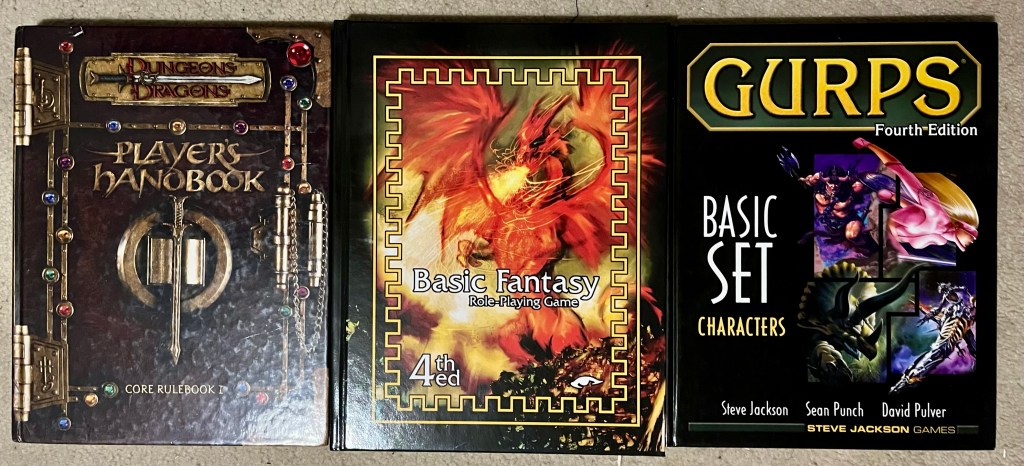
I’d been playing D&D 3e and 3.5e since 2000. In 2006, I was finding out about what was quickly becoming known as the OSR. Publications like OSRIC were hitting the market in this period, as was Basic Fantasy Role-Playing Game (2006) from Chris Gonnerman. It’s interesting to me that I was looking back over my shoulder but I was looking to the rulebooks rather than the method of play.
I believe the Chinese say something like, “The best time to plant a tree was twenty years ago. The second best time is now.” I think the core of my answer to the question is that it would have saved me a lot of angst and money if I had broken out of the belief that buying a new rulebook was going to improve my experience of play at the table. What I have profound relief about today is that I’ve at least planted that acorn in the past year.
What my heart was aching for – although I could not have articulated it back in 2006 – was to return to the role-playing of my youth. This was a nostalgia for the kinds of long-form cooperative gaming groups that I spent a little over ten years apprenticed within as a teenager. Somewhere along the way, I’d come to believe that the rules of the game were somehow going to make my play at the table better, but the reality is that I needed to return to the role-play in RPG.
Roleplaying, or role-playing, is a conflation of role and play. A role is a persona that a human being takes on and pretends to become within a chosen context. Play, another slippery concept, is an activity which engages our enthusiasm and imagination, often challenging us in a variety of ways. Roleplay takes place within a specific context: in RPGs, this is often referred to as the setting of the game.
What I was needing, back in 2006, was to focus on learning how to inhabit a specific persona within a setting and explore that character and their Otherworld. As a GM, I needed to work on methods of play that would help other people achieve this goal at my table. I’d been running dozens of short-lived campaign starts that fell over within about six sessions. I didn’t know how to sustain a game I wanted to play.
Roleplay Rescue ultimately unlocked the pathway to a series of realisations that, honestly, I wasn’t ready for even in 2018. The first was that I had two hobbies: collecting RPGs and not-quite-playing them; the second (which the OSR gave me) was that player choice is the primary strength of the RPG medium; the third was that RPGs are fundamentally games of exploration, discovery, and “Otherworld immersion” rather than vehicles for emulating movies, books, or cinematic superheroics.
From these insights, I began to formulate a new methodology, feeling my way towards a different approach to the actual play of these games. I slowed my collecting hobby (saving me money as much as time). I began to focus on techniques like back-seating the rules of the game through experiments with rules opacity. This led towards choosing to master a particular limited set of rules and choosing specific settings to explore. I began to see RPGs as ‘infinite games’ rather than limited one-shot or short-shot experiences.
The catalyst was a mental health breakdown in 2020. Fighting back against rabid anxiety, I developed Tiny Prep as a method. Conversations with Runeslinger, of Casting Shadows fame, began in 2023 but took full bloom in 2025 as we began to talk about the ‘Story Divide’: I was introduced fully to the distinction between playing to inhabit a character in an imaginary world versus playing to collaboratively produce a narrative arc.
October 2025 was the beginning of the Karameikos campaign, the first time that those yearnings from 2006 finally took hold and found an expression in actual play with a group who wanted what I wanted from the game: deeply inhabited characters playing in a fantastic Otherworld and using consistent, grounded rules that took a backstage role. The focus has been on the role-play. A year later, the game is maturing and I’ve found what feels like home in my hobby.
The difference is that I am no longer a teenager, nor am I stuck in a nostalgia for something that never quite was what I remember. I’m not playing games that use any elements of the stuff I played in 1989: I never played GURPS, nor really D&D since 1983, and certainly not in Mystara. The only piece that has been carried through has been the experience of playing in-character as-character, which is the experience that brought me so much joy since the first time I played Traveller with my friend Daniel.
Looking ahead, if I am extremely fortunate I might have another twenty years to enjoy the hobby. My hope is that I continue to play in one or two games that allow me to enjoy the experience of either playing a role in-character in the sort of fantastic Otherworld that interests me personally, or help other people enjoy that experience by running games of that type. Right now, I am focused on capturing the things I have learned and composing a guide to the methods I’ve discovered.
Here’s hoping that I get the chance to role-play for as long as humanly possible.
Game on!


Pleased you have found a new thread. Although I was lucky enough to play the original D&D and so embraced role playing alongside wargames all very communally, for some reason I have always had the otherworldly ideas from my comic book days as a young kid when I simply used plastic toy soldiers (ray guns and spears mixed up) which were to hand to play out games 100% imaginary 0% rules. Being solo meant there were never any arguments over the non existent rules! The net result? I love buying and reading rulesets but rarely play them neat unless they are very simple. Yet I really like the depth of design in some rulesets.
LikeLike
I love the way you put it – two hobbies, one playing the game and one collecting books. That so describes me…
Though I realised a while ago that it’s not the rules that interest me, it’s the stories we discover, and so I have been running 5e (because it has the highest player familiarity) in Mystara (because that’s the setting I fan-boyed over in the 80s and have all the books), since between them they support the stories I like.
LikeLike