
I’m writing this post to record my confession about the fact that, for about a year now, I’ve been experimenting with using so-called AI in my TTRPG game prep. I realise that in certain parts of the internet, this will get me branded a heretic and my GM Screen burned at the stake. Perhaps I’ll be on that stake, too. Who can say?
First, though, you need to recognise a few other facts that relate to my usage of an LLM. Yeah, I don’t think it’s even remotely “intelligent” in a meaningful sense. But that’s a philosophical discussion for another time. An LLM does not have a “mind” and cannot hold a mental model. It cannot truly “create” (or, more precisely, “subcreate”). It’s a piece of software; a digital secretary.
I don’t “storytell” at the table. I do not hold the position that RPGs are about storytelling. I hold the view that RPGs are, weird as it might seem, role-playing games. They are about playing the role of an imaginary character in a fantastic Otherworld. Yes, story emerges from the playing of the game. But the story is a product. The player’s choices, the GM’s adjudications, and the game rules together lead to outcomes.
I play in Open Worlds. I prep by looking at the current player characters’ in-world goals and asking myself, “What might stop them from getting what they want?”—in other words, I set up Obstacles. I’ve found Jamison’s Obstacles to be the most useful prep tool I’ve encountered to reduce my prep load and allow me and the players to retain maximum creative flexibility at the table. I prep situations, not plots. Players make choices in-character, as-character. This is playing the psychological position of the PC.
I use the LLM to outsource and support me in reducing the boring tasks that I don’t enjoy doing, but which—being a Large Language Model—it is good at doing. I use the LLM to help me maintain a consistent set of in-world ‘canon’ lore and quickly allow me to search it for facts. I use it to kickstart me when I am stuck with a blank page. I use it to format text for my prep notes.
I do not, contrary to popular opinion, use it to half-ass my creative authority.
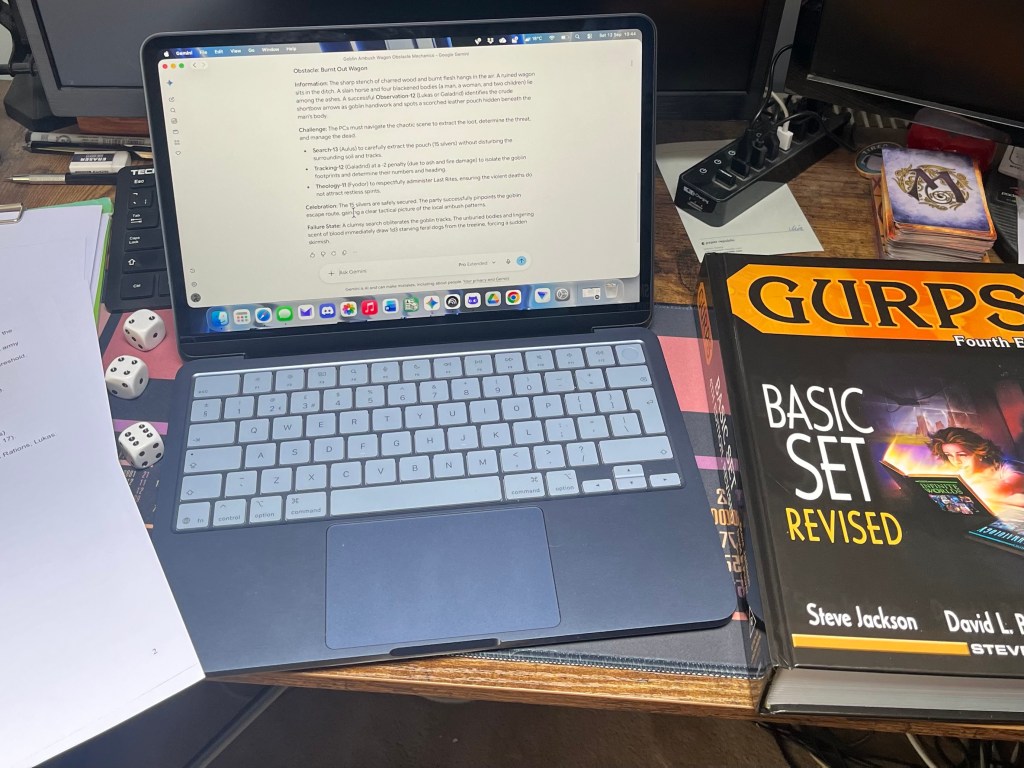
Use Case #1: Formatting Prep Notes
Prep notes are personal. They are not intended for publication. They are for keeping your head straight at the table when you are the Gamemaster. They are allowed to be messy and rough. Because I play in an emergent Otherworld with Open World principles, I create what I need for the next session. Certainly, sometimes I get excited about some aspect of the setting and do extra prep, but largely I just prep for the next four hours.
In the past, I would sit with a laptop and stare at the flashing cursor on a Word doc. Before that, because I am that old, I would sit with a pad of paper and stare at the lines. The problem is that I don’t like making notes. At University, I would go to lectures and listen. I would retain the learning by going and speaking about it with others. I would write down what I needed afterwards, usually in a Mindmap™ or in simple note form. For RPGs, I would get pre-game jitters and feel blocked.
In case you don’t know, I am an anxious person. I worry. I doubt myself constantly, and I don’t really believe I am any good at this stuff. I am expecting a barrage of hateful comments once I post this because, clearly, it’s shit. I know that is just my paranoia and anxiety talking, but it has been around in my head my whole life, so… yeah. Long and short of it: I used to look at my notes and ask if I was doing it right.
Jamison’s Gamemastering helped me. The Alexandrian’s blog helped me. Even the f*cking AngryGM helped me. How? Those guys gave me minimalist frameworks for prep: templates. It turns out that this is something that LLMs eat for metaphorical breakfast.
My PCs are going to find a burned-out wagon along the trail north from Threshold? Cool. I type a rough description of what the situation is, maybe add specific details I want to include, and then type /obstacle into my Gemini Gem. It spits out a formatted Obstacle using the template Jamison recommends.
The prompt:
The PCs will find a burned out wagon by the side of the road. There’s burned bodies and horse slain by arrows. There’s a small pouch with 15 silvers hidden under a body. There is a man, a woman, and two kids dead. Goblins did it. Add clues as necessary.
/obstacle Burned Out Wagon
The result:
Obstacle: Burnt Out Wagon
Information: The sharp stench of charred wood and burnt flesh hangs in the air. A ruined wagon sits in the ditch. A slain horse and four blackened bodies (a man, a woman, and two children) lie among the ashes. A successful Observation-12 (Lukas or Galadrid) identifies the crude shortbow arrows as goblin handiwork and spots a scorched leather pouch hidden beneath the man’s body.
Challenge: The PCs must navigate the chaotic scene to extract the loot, determine the threat, and manage the dead.
- Search-13 (Aulus) to carefully extract the pouch (15 silvers) without disturbing the surrounding soil and tracks.
- Tracking-12 (Galadrid) at a -2 penalty (due to ash and fire damage) to isolate the goblin footprints and determine their numbers and heading.
- Theology-11 (Fyodor) to respectfully administer Last Rites, ensuring the violent deaths do not attract restless spirits.
Celebration: The 15 silvers are safely secured. The party successfully pinpoints the goblin escape route, gaining a clear tactical picture of the local ambush patterns.
Failure State: A clumsy search obliterates the goblin tracks. The unburied bodies and lingering scent of blood immediately draw 1d3 starving feral dogs from the treeline, forcing a sudden skirmish.
Cut. Paste. Done. About two minutes of typing and about a minute of waiting, then about two minutes to review and edit—in this case, I’ve left it pre-edit.
Oh, and the numbers, those are based on the PC character sheets it has access to. I set the Gem up to pick the best (most likely) score for quick reference. The Feral Dogs are a previously created NPC type statted in earlier prep, and the main thing I would remove in edit because I don’t want this to be a fight. If I did, I would redirect the LLM to add them to the encounter as already present and set this up differently. I think you get the idea.
Use Case #2: Keeping Lore Straight
The LLM cannot hold a mental model because it doesn’t have a mind. It’s holding information in a limited context window. It’s predicting the most likely next best word in the sentence. It’s able to process the words and re-present them to the user. In McGilchrist’s terms, it’s doing what the left hemisphere of the brain is good at doing… just less well. It has no sense of the whole, or the relationships between, or the “big picture.”
To use an LLM, you really need to know your shit. You need to hold the mental model and maintain the boundaries of whatever knowledge you are asking it to process and work with. If you are not an expert, you can find yourself reading crap that you can’t tell is bullshit. You need to know enough to call out the LLM when it hallucinates. Personally, I don’t usually engage in correcting it; I just open a new chat and start from where we got to. But I digress.
I use NotebookLM to help me keep my campaign lore straight. Karameikos has two notebooks: one for the “official” canon of Mystara; the other is for the emergent “personal Karameikos” lore. The latter takes precedence, and the Gem I use knows it. In short, I can quickly search the lore for answers to questions during prep (and even during breaks in-session); I can ask it to collect lore from multiple sources and re-present it to me; I can dialogue about questions I might have relating to lore.
But I know my campaign. I use it to do the referencing I don’t want to do by flipping through the 38 sources in my official canon notebook. I own them in PDF and many in paper, too. I paid for the books. Notebook utilises only the sources in the notebook to answer questions. This is for personal use, and it saves me a lot of time. One practical extra use has been to extract summaries for player consumption on a topic, which I share as 1-page reference documents with PC-facing information only.
It helps me keep the exact details straight. I know my shit, but I can’t remember everything. I used to use Campaign Logger to organise my notes, but I am crap at typing them in. I’ve tried using the AI Companion on Zoom to give me a summary I can cut and paste, but it’s not particularly granular. In the end, I make my prep notes and I write up a post-game narrative filled with key details that feel necessary to remember. I give these to Notebook, and it spits back details when I ask.
Use Case #3: Writing Up the Emergent Story
I am not anti-story. As a role-player, I believe that the story emerges from play. It’s the tale we tell after the fact down the pub. Not that we go down the pub, because we play online, but you know what I mean, right? The problem is that I am shit at taking notes in-session. I am focused on running the game: presenting the situations, listening to the players, adjudicating the rules—all that stuff that is the joy of RPGs.
On the morning after a session, I open up LumoAI and I upload the session prep document. I select the “Writing Assistant” tool, and I type in my recollection of the opening scene of the session. I fill it with details, game rules stuff, whatever I can remember. It spits back a few paragraphs of narrative that emerged from the play. I cut and paste it into a Google Doc, I edit it lightly, and I repeat. I do this until I have the entire session captured.
My emergent story narratives get long, usually about 10-15 pages. They include dialogue I can remember and sometimes dialogue that’s close to what was said, but I couldn’t remember exactly. It describes things based on the prep note descriptions. It interprets mechanical outcomes into player-facing narrative. Overall, it quickly generates a “good enough for jazz” narrative record which I can then upload to Notebook. This stuff becomes a “canon” guide for Use Case #2.
I enjoy working this way. I get a story I’d never formally “publish,” but which is good enough if a player missed a session. I get to capture the details of what happened from the perspective of the GM watching the game emerge. It’s human-based and focused on my perception of the events. I get to relive the session in my imagination and then record the outcome of the game. It increases my sense that, “Hey, that was a good session” because I get to feel the arc of the emergent narrative.
In the past, I would not make good notes. I’d lose notes. I’d forget details. I’d have the sense that my game was a hot mess of disconnected scenes. I’d get anxious. I’d not want to prep, get afraid, run a session on the fly, not write it up, rinse and repeat. I’d get three to six sessions deep and kill the game.
Nowadays? I’m nineteen sessions deep, loving the game, not terribly anxious about it, and I enjoy reading the backstory that has emerged over all those sessions.
So yeah, I use LLMs. I use them for way more things than this, but these are the big three for me. I find them bloody useful because they reduce the friction I feel when running a TTRPG. Over the past three years, I have run more and better TTRPG campaigns for both face-to-face and online groups. Since last year, after working slowly to figure out how to utilise LLMs, I’ve grown in confidence as a GM and played more sessions in long-form games that I enjoy better.
Game on!


I use an LLM in a similar way for my current Dolmenwood campaign. I’m a terrible note taker so the biggest help to me is I use a discord bot called Craig to record my sessions. It is able to record each participant on a separate track. After the session I run those tracks through a transcription app (also LLM powered) and load the time stamped individual transcripts for all the participants into ChatGPT project sources. It then generates very detailed session notes, with XP awards and a character progression ledger for PCs and hirelings. I then add it to a compiled reference in the project sources. Makes GM life so much easier. And if the PCs take a hard right in a session I can query the LLM for canonically constant ideas in session too. Really changed my GM life for the better and helps me run a better game.
LikeLiked by 1 person
Hi Che,
Mining your own text/data is right in the LLM sweet spot as I understand it, and didn’t village anyone else’s copyright (which is my major gripe about a lot of the generative AI out there). This signs like a great use of the technology.
Would you mind sharing a bit about the exact LLM tools you use and how fed them, particularly your background information? I sort of get hints from the description above, and if I knew more I could probably recognise them, but I can’t work it out.
Ian
LikeLike
I use LumoAI for anything narrative I am putting together for my records, as described. These documents are saved as Google Docs and uploaded to NotebookLM. That notebook also gets anything else I create (lore & stats) – items, creatures, NPCs, factions, organisations, whatever. I write (or generate & edit) as I need it. Generally, I take the Tiny Prep approach: everything starts as a single line of description and grows as I develop it and/or it is used in play.
LikeLike
Hey Che! Thanks for sharing this “confession.” I really appreciate your insights, and couldn’t agree with you more regarding what role playing games actually are: the game’s the thing, the story’s the product. Also, I appreciate your distinction between creation and subcreation. Tolkien, I presume?
I also have been using AI in recent months, to solo role play. I’ve set up Gemini Gems to serve as DM, and I’ve used Notebook LM to track rules and lore. After several sessions, though I’ve seen some impressive things, I don’t like it much. Unlike you, I’ve used Gemini to generate content so that I could experience exploration and discovery as much like a real player as possible. However, the experience is ultimately bland and hollow. I might continue to solo role play, but I probably won’t be using AI for any creative tasks going forward.
I like your three use cases. As a software engineer, I am essentially forced to use AI at work for various tasks, so I am familiar with some form of all of these use cases, and I think they’re solid. I feel queasy about AI, generally, but I’m learning where it can be most useful, and where it should keep clear away, and your three use cases describe pretty much where I’ve landed. When organizing your thoughts, summarizing information, and keeping track of large or complex sets of data, LLMs excel. And I’m comfortable using them in that capacity.
Look forward to reading more. As ever, thanks for sharing your journey. I’m glad that you’re enjoying your Karameikos campaign!
LikeLike
Thanks for the feedback.
On the use of LLM for generating ‘creative’ stuff and being a solo GM… erm, no. I use Mythic as my GM Emulator when solo. An LLM cannot hold a mental model and they are bland as heck.
LikeLike