
This post’s a rant about how the RPG hobby is plagued by a lack of citation and credit when it comes to talking about GMing, playing, and generally getting the most out of role-playing games. The short version is that it irritates the heck out of me when someone makes highly confident advice statements based on someone else’s ideas and totally fails to as much as mention their source.
Why does this matter? Because when I read a GM advice book, I can’t tell what’s new, what’s borrowed, or from whom. When I listen to a podcast or watch a video, it’s the same – where does that idea come from? How can I find out more?
For me, the problem is that I’ve always felt that it’s worthwhile – as much as I am consciously aware of my influences – to share my working: the sources at least passingly credited. When I started RPR, way back eight years ago, I remember one of the pieces of positive feedback I got was exactly this point: people said they enjoyed the fact that I pointed to my sources, especially when quoting or talking about published work. It wasn’t a formal citation but I at least mentioned the author names and book titles.
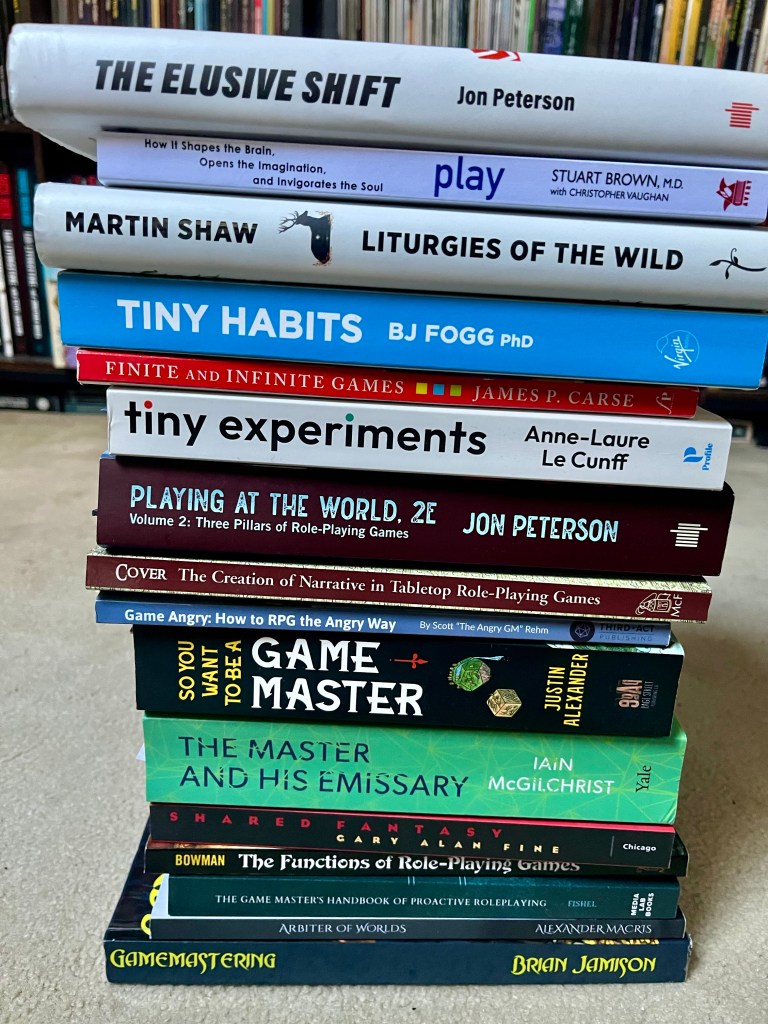
Deeper than this, I think one of the reasons we keep ‘reinventing the wheel’ in the hobby has to do with this citation problem. Back in the early days, fanzines like Alarums & Excursions, while amateur and basic, did a good job of connecting ideas and sources back to their contributors. My impression is that, as the RPG hobby started to try to become an industry (and standards of publication professionalised), this connection to our do-it-yourself supportive community got severed.
I doubt it was conscious and deliberate, honestly. But I think that the desire for the ‘expert voice’ in published books meant that you were perhaps less likely to cite your sources. Forums were a mixed bag, where some people cited connections but many didn’t. By the time we got to blogs, podcasts, YouTube, and social media the whole culture was more about grabbing attention than any kind of pretence to academic rigour. Now, maybe it’s more about ego and haste.
Why it matters to me right now is that I am codifying my own GM approach into a book and I’m taking the time to try and track down my sources. The frustration is that so many sources – outside of academia – just don’t give us a clear picture. One small example: Vincent Baker wrote Apocalypse World and is often credited for creating the countdown clock idea. But, given the date of publication, one rather suspects this idea has an uncredited deeper lineage. We simply can’t really know.
Here’s an example from my own work:
Back in August 2020, I wanted to resurrect the Fire Citadel of the Dragon Kings as a megadungeon for an open table, but the sheer volume of mapping and keying felt daunting. The original Dungeons & Dragons advice is to have at least three levels ready before you start, and that seems like a doable idea until you actually sit down to do it. Around the same time, I was reading BJ Fogg’s Tiny Habits (2019), and I remembered something Peter Dell’Orto had written on his Dungeon Fantastic blog: if possible, draw a room or two on the map every day. His post, “My megadungeon mapping ‘best’ practices – Part I”, went up on 30th December 2011.
So I put the two together. Every time I pressed start on the Tassimo coffee machine, I took down my pad of 7mm hex paper and added at least one room to the map. Separately, I tried to write up one location key a day, having just re-read the Alexandrian’s Art of the Key articles. In about a week, I had a full A3 sheet of dungeon, which would have felt like hours of daunting work if I’d sat down to do it in one go.
I talked about all of this on the Dungeon Master’s Diary (#46 Part 2, published 23rd August 2020), naming Fogg, Dell’Orto and the Alexandrian as I went. I came back to it on Roleplay Rescue in “Not Letting Work Kill My Hobby” (26th September 2020), and eventually formalised the whole approach as Tiny Prep in an episode of the same name (1st October 2022).
Two months after that, on 5th December 2022, Sean McCoy tweeted the idea that became #Dungeon23: a megadungeon built one room a day, every day, for a year. It took off in a way none of my stuff ever has (not that I’m bitter… well, maybe a little).
Now, I want to be clear: I’m not claiming McCoy took the idea from me. I have no reason to think he ever heard my show, and good ideas often bubble up in parallel. Besides, I wasn’t first either. Dell’Orto was doing it nearly nine years before me, and I suspect someone was doing something similar before him. What I added was Fogg’s framing, a deliberate prompt, and the split between mapping and keying. That’s a remix, honestly, and I’m comfortable with that.
But that’s exactly my point. Because I named my sources at the time, you can follow the trail back from me to Dell’Orto and Fogg, and from Dell’Orto to the sources he credited in turn. When an idea takes off without that trail, the history simply disappears, and the next person to say it loudly gets the credit. Multiply that across fifty years of the hobby, and it’s not hard to see why we keep reinventing the wheel.
So what am I actually asking for? Not much, honestly. I’m not suggesting that every podcast episode needs a bibliography, or that every blog post should read like a journal article. When I started Roleplay Rescue, I didn’t read out formal citations either. I just mentioned the author and the book title as I went, and people told me they appreciated it. That’s the bar: a breadcrumb, so that someone curious can go and find out more.
If you write, podcast or make videos about running games, name your influences, even roughly. If you can’t remember where you first heard something, say so: “I think I picked this up from a forum thread years ago” is still more useful than nothing. If you’ve had an idea of your own, put it out there with a date on it, and if you build on someone else’s, link back to them. And if you’re a reader or a listener, ask the question: “Where’s that from?” Most of us will be glad you asked.
I’m trying to hold myself to this as I work on my own book, and I’ll be honest, it’s harder than it sounds. Tracking down sources takes time, and there are ideas in my head that I’ve absorbed from so many places that I can’t untangle them any more. But I’d rather say that plainly than pretend I invented it all. The early fanzines managed it, and Jon Peterson’s The Elusive Shift (2020) shows how much of what we think of as new was being argued about in their pages back in the 1970s. If they could keep the conversation connected with typewriters and a postal service, we can manage it with hyperlinks.
The hobby is fifty years old now. It has a history worth knowing. Name your sources. Date your ideas. Follow the trail back.
Game on!

