
I have spent a significant portion of the last few years trying to repatriate a ghost.
I suspect many of you are doing the same. We look back to that first spark—for me, it was 1980, aged nine—when the world suddenly became larger than the suburban streets of my youth. We remember a feeling of total, unshielded immersion. It wasn’t about “winning” a game or optimising a build; it was the intoxicating, slightly dangerous proposition of being someone else, somewhere else. It was the “as-character” experience in its purest form.
For a long time, I laboured under the delusion that the magic was trapped inside the physical artefacts of that era. I thought that if I could just find the right version of the Basic Set, or the perfect iteration of a d100 mechanic, I could recreate that sense of grounded reality. I was chasing “System Nostalgia”, assuming that the dice-maths was the same thing as the wonder.
The reality, I’ve discovered, is that we often try to rescue our childhood hobby by returning to the exact rules that—if we are honest—actually got in the way. We want the world to feel heavy, consequential, and real, yet we reach for abstract systems that treat our characters like a collection of hit point buckets and arbitrary levels, or limit us to a set of slightly too-broad skills.
I’ve realised that I don’t want to play 1981 again. I want to feel the way 1981 felt, but with a system that actually has the fidelity to support the weight of a living, breathing Otherworld.
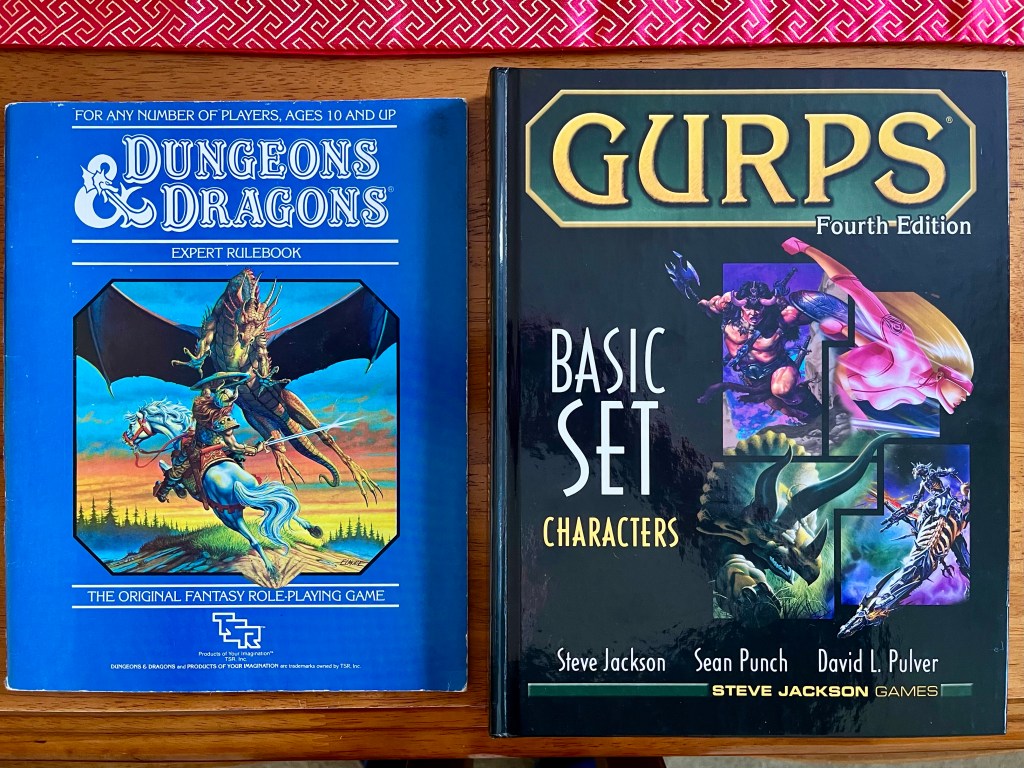
My relentless chase for this feeling led me through the star-charts of Traveller and the formidable tables of Rolemaster. Even during my teens, I wasn’t just playing; I was seeking a system that could match the scale of my imagination. With Traveller, I found myself drawn not just to the mechanisms, but to the Third Imperium as a cohesive, functioning “Otherverse.” I wanted the world to make sense.
Rolemaster was different. I fell into the “system trap”—the allure of endless tables and granular detail. Yet, what I truly loved was the openness of character design and the depth of the skill and magic systems. I wanted a character who felt like a unique inhabitant of the world, not just a class-based archetype.
In retrospect, I was trying to build a high-fidelity experience using the most complex tools I could find. But as many of us discover, there is a fine line between a system that supports the world and one that eventually smothers it. I spent years wandering in a “Rules-Lite” wilderness, thinking that shedding the weight of these complex systems was the only way to keep the game alive.
It was only relatively recently, through a pivotal conversation with Sean Punch in April 2020, that I realised I had been looking at the problem from the wrong end of the telescope.
The Subtractive Epiphany
In a conversation with Sean Punch that aired exactly six years ago, I encountered an idea that would eventually dismantle my fear of “crunchy” systems. Sean described GURPS as a subtractive, descriptive toolkit. It was a revelation that moved at a glacial pace through my subconscious until it finally clicked into place.
Most modern games are prescriptive. They provide a narrow menu of options and tell you, “This is what you can do.” You are playing the rules. Sean’s insight flipped the hierarchy: you describe the Otherworld first—the specific dampness of a Karameikan cellar or the weight of a broadsword—and only then do you reach into the toolkit for the rule that best describes that reality. The system is the servant to the setting, never the master.
This realisation rescued me from the “Rules-Lite Trap.” I had previously assumed that to have a fast-paced, immersive game, I had to strip away the mechanisms until almost nothing was left. But “rules-lite” often lacks the consistent physics required for a long-form campaign; it leaves the GM constantly inventing new rulings just to keep the world from wobbling.
By using a robust system like GURPS as a subtractive tool, I found I could have the “least rules” at the table without sacrificing the groundedness of the world. I don’t need to use all five hundred pages of the manual; I just need to know that those pages have already done the hard work of testing the physics so that I don’t have to.
Arriving in Karameikos
The ultimate proof of this approach, for me, lies in my return to the Grand Duchy of Karameikos. This is a setting that lives in the 1983 D&D Expert Set; it is a place of nostalgia, defined by that iconic hex map and the misty, frontier promise of Threshold. In my mind, this was always a place where the “as-character” dream lived. I wanted to visit Mystara and explore it.
Yet, today, my Karameikos is powered by GURPS.
To some, using a high-fidelity system to run a “Basic” setting might seem like overkill, but it has been my “arrival.” By treating the system as a descriptive servant, I have finally achieved the groundedness I was seeking as a nine-year-old in 1980. When a player swings a blade or negotiates with a Baron, the rules provide a consistent, pre-tested weight to the outcome. I am no longer making it up as I go along to compensate for a “lite” system; I am acting as the Sentinel of a world that feels physically real.
I haven’t rescued the 1983 BECMI rulebooks, and I don’t need to. I have rescued the experience of being there. By letting the “Emissary” of a robust system handle the physics, the “Master”—the imagination—is finally free to wander the forests of the Wufwolde Hills without looking back.
I am no longer chasing a ghost. I have finally arrived at the table I was always looking for.
Game on!


The system is the servant to the setting, never the master.
Amen! Thank you for this post, which so neatly articulates this point of view so well.
LikeLiked by 1 person
Hi Che,
Our experience seems very similar. Born 1971, I “grew up” with BECMI (well, BEC TBH – only reached the low 20s level, so my M and I sets were just for dreaming…) and Karameikos. I then had a long gap before restarting in 2017. My campaign is still based in Mystara – now in Darokin – but I’m using D&D 5e (approximately, with imports from 2024, ToV and Level Up!). I have thought about other systems, but like with you, it’s the story that I care about, and the rules are just a prop for telling the story, so my blend of 5e-ish systems does the job.
Glad to see you back.
Ian
LikeLiked by 1 person