
This post summarises a line of thought that has been a very long time in coming. It’s a post aimed towards those friends, both on- and offline, who sometimes enjoy playing RPGs with me. It is an invitation to experiment with key assertions I have been making over the past 5 or more years of Roleplay Rescue.
There comes a time when many a roleplaying gamer realises that they are unsatisfied with the way in which the game is being played. I’ve been in this place for longer than I can remember, and I have attempted to resolve this in many unsatisfactory ways. I recognise that the problem has been methodological.
Yesterday, while running a very enjoyable one-shot adventure for a friend who is new to the hobby, I hit an uncomfortable realisation: as much as I wanted to continue playing within the world of the game and with those particular players, I didn’t want to continue with those rules or the regular method.
That new player expressed to me the wonder of the imaginary Otherworld they experienced in their mind. They described the challenge of learning the rules and numbers as interrupting their enjoyment of the imagination. They described an experience of not being able to easily switch from images to numbers.
I want to offer players the opportunity to experience a more fully Otherworld-immersed game, focused on enhancing the dialogue of play so that players can increase the imaginary invocation of the World – the imagined environment – and their decisions as a Character – an alter-ego they are pretending to be.
The road towards running such a game runs through a fundamental shift in the method of roleplay gaming. Today, I sat down and wrote a very lengthy essay as a means to working out my own goals and direction. Oscillating between wanting to be liked and wanting to do things differently is a behaviour I need to cease.
One outcome of that process was to derive a draft set of principles or goals that would move my roleplaying nearer to Otherworld-immersed play:
- Enhancing the dialogue of play so that players can focus more on the imaginary invocation of the world and their decisions in-character.
- Greater ‘rules opacity’ so that fewer mechanistic terms are used in the context of play; reducing the “game talk”, increasing the “descriptive talk”.
- Decreasing the space between the perception of the imagined character and the perception of their player while in the game world.
- Ensuring players have a strong sense of their agency within the game.
- Retaining the tactile action of players rolling the dice when they declare an action.
- Reducing the volume and complexity of the rules that are in play.
- Deploying effective scenario structures which give the game a clear sequence of play.
- Ensuring each character has a specific role to play in the game which is unique and protected.
- Evolving new ways of presenting and tracking detailed player character information for the GM’s eyes only.
- Recognising that each individual game run – that specific mix of world, methods, rules and players – will need to be created as its own entity.
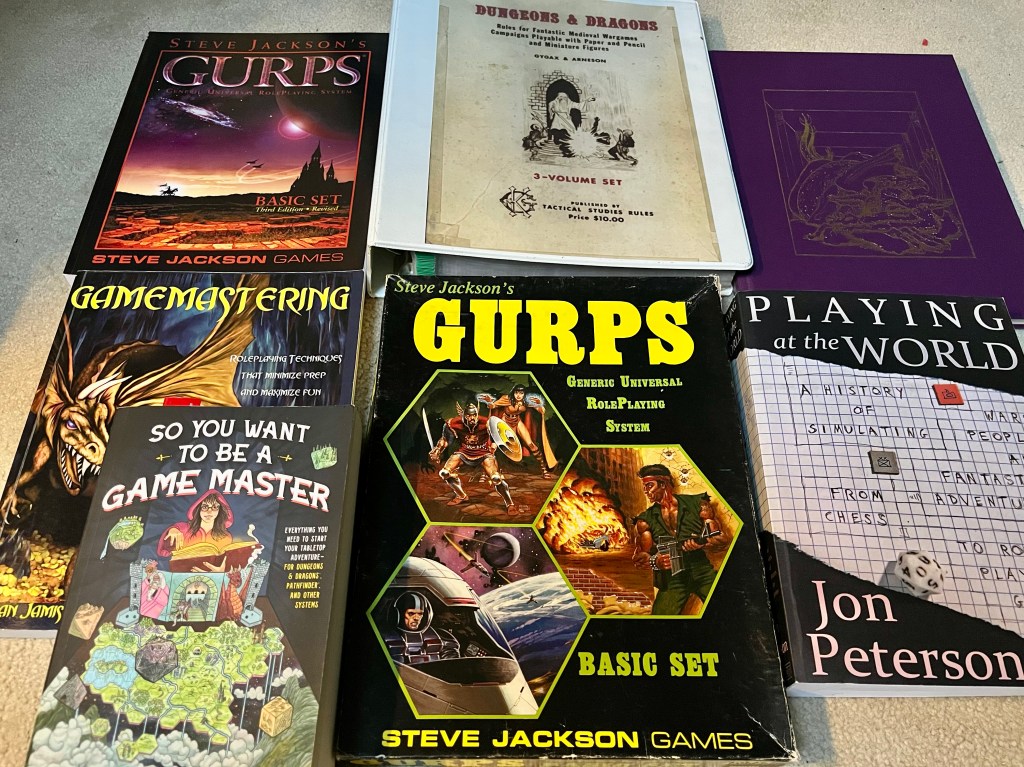
A deep sense of wonder arises from two areas of RPG history: (a) the earlier editions of GURPS and (b) early Dungeons & Dragons, including the “Ur level” recovered by Peterson’s Playing At The World (2012, 2024) and The Lost Dungeons of Tonisborg by Svenson, Morgan, and Boggs (2021).
I’m reminded of advice from Jamison in Gamemastering (2011) to begin with agreeing a setting, choosing the game system, co-creating characters, and sketching the first adventure prior to starting play. The selection of game system is for me the sub-set of GURPS rules that I choose.
Neither of my groups has consented to my experiment. Therefore, while seeking to get down to brass tacks and design a bespoke GURPS-powered world is exciting, I need to discuss any new games with the players. An Open Table design would instead be the best starting point until such discussions occur.
Open Tables are, as Justin Alexander proposes in So You Want To Be a Game Master (2023), an excellent alternative to what he terms the Dedicated Table – the regular expectation of people turning up regularly to the same game over an extended period. Open Tables are:
…built around (a) campaign material that’s already set up so you can run the game with little or no prep and (b) open group formation, so that you can play a session with any combination of players.
The most straight-forward approach to setting up an Open Table is to create a classic megadungeon:
The PCs are dungeon-delving adventurers based out of a town near (or, alternatively, directly on top of) the megadungeon. Each session, a group of PCs will form an expedition that will journey down into the dungeon.
As I have realised several times over recent years, an Open Table is a great game to create and put in my “back pocket”. It also offers me a simple means to begin crafting and shaping a game world, the methodology, specific GURPS rules, and character creation options towards a specific roleplaying game offer.
Struggling to articulate this happens because it is both emerging from my mind and defying explicit expression. I sense that the only way I can truly arrive at the thing I am wanting to engage in is to create that game and play it. All I can do is appeal to your patience and curiosity in the meantime.
Thanks are due to myriad players, listeners, and fellow-travellers who have persevered and taken part in my roleplaying game journey. I am especially grateful to those who have weathered sitting at my table in play. You have all helped me grow, change, and develop as a gamer. Thank you!
For now… game on!
 Roleplay Rescue’s Blog
[…] all set to run a game there with anyone else who’s interested. Given that last weekend I was sketching ideas for a megadungeon in the same world, it’s now trivial to turn those plans towards GURPS 3E and […]
LikeLike
[…] couple of weeks, I’ve been actively pursuing experiments with different groups of players to enact those principles which I believe will move us closer to experiencing roleplay in a more distilled or rarefied form […]
LikeLike