
This week, in preparation for what could just be a one-shot but which might just as easily grow a pair of legs, I’ve been building a first adventure to play with Basic Fantasy RPG. One of the most useful distinctions I’ve come across is the one The Angry GM makes about “big prep” and “little prep”:
…you end up doing big prep and little prep. When you realize you’re gonna need a new adventure soon — because the heroes are about to finish an adventure or they just finished one — you do big prep. You come up with the adventure’s premise, its major conflict, and figure out its structure. That way, you know what the adventure’s about and how it’ll probably play out. In broad strokes.
Then, you do the little prep. That’s where you build out the acts, fill in scenes and encounters, draw maps, stat s$&%, and so on. And you can mostly do that on a session-by-session basis. Do it as you need it.
theangrygm.com/simple-campaign-next-adventure/
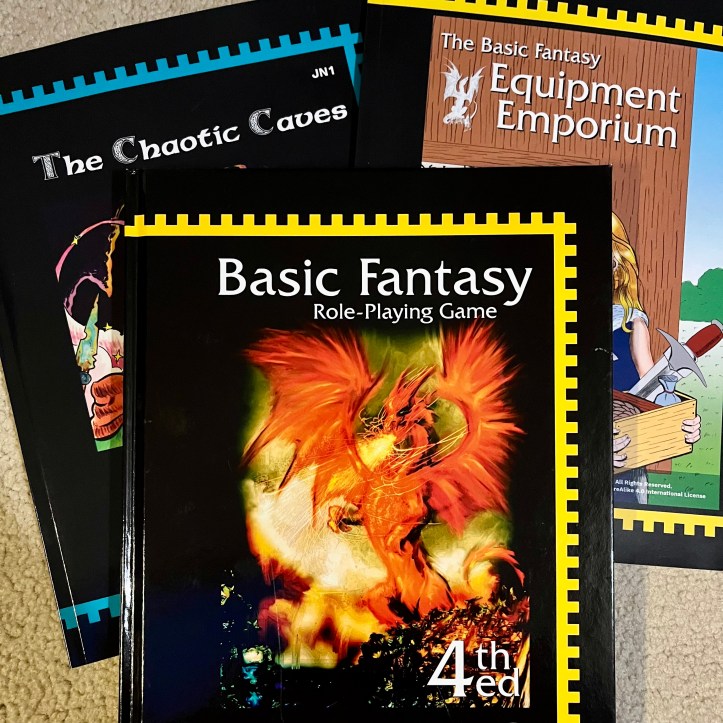
This week’s adventure building has been a “big prep” moment followed by some “little prep” in close succession. What I like about Angry’s distinction is that it helps me focus on what I need to do with my prep. Sometimes I am just dropping big ideas – say the name of a location – into my world. When it comes time to do “big prep” I take that idea and flesh it out. Eventually, I’ll need to handle all the “little prep” details.
One of the most useful things that Basic Fantasy provides me with is a lot of tools and materials that I can do the “little prep” with, such as monster stats and treasure tables. In a time-pressed life where prepping for a game has to come in little slices of effort, having easy-to-grab “little prep” details is a relief.
While for a long time I felt disappointed with the experiences had with “rules lite” and old-school retroclones, the reality as I sit here today is that prepping two adventures this week has been both much easier and much more enjoyable than I expected.
While I love the tactical detail and options available in a more thorough rules system, the pressure to invent all the “little prep” from the myriad options available is a problem. Even trying to grok the abilities of, say, a GURPS or Pathfinder monster is a large cognitive load. The much more abstracted stats from retro D&D-like games are frankly easier to deal with.
Is this the death of my love affair with crunch? I doubt it… but I am questioning the wisdom of playing games focused heavily on rules detail when, at heart, what I really want to focus on is creating an interesting fantasy world and running adventurous players’ characters through it.
I’m curious to see how the playing of the adventures I’ve written feels at the table. One is an online game and the other is face-to-face, so there’s a lot to experience and reflect upon. From where I am sitting after doing the “big prep” to start a new fantasy campaign, it was a lot easier and a load more fun than I expected.
Game on!
 Roleplay Rescue’s Blog
I usually do a lot of big prep and worldbuilding, then minimal little prep. Once I have a handle on my setting and the major NPC, locations, and creatures in it, I can usually go a long way into the game by improvising responses to the PCs actions before I need to do significant prep again.
One way to avoid getting bogged down in the mechanical details of creating a monster in GURPS is to just ignore the character creation rules. It doesn’t have to follow the same rules for making a PC. Especially for a fantastic or fictional creature, no one can point to it and say it’s not modeled realistically. It’s your creation—you decide how it works.
This isn’t just ignoring character points—it doesn’t have to be built using the Advantages and Disadvantages system at all. Just make up and write down what its capabilities are: how much damage it does, what effects its powers have, etc. Then, stick to those in play to be consistent. As Douglas Cole says in his Nordlond Bestiary, “Monsters Cheat.”
The only time a creature, monster, or even an NPC has to be built by the character creation rules is when they will be an Ally, Dependent, or Enemy of a PC, and you need to have an idea of their point total to know their value as an Advantage or Disadvantage on the PCs character sheet. Even then, estimating is probably ok.
LikeLiked by 1 person
This is an interesting idea. I have The Dark Eye’s 5th edition rules as well as some sets of GURPS, and the complicated nature of enemies has always put me off. Perhaps this idea of ignoring them completely (for the enemies, that is) would help me actually put those games on the table.
LikeLike
[…] been very much enjoying immersing myself deeper into the newly-born Dragonreach setting that I began to create using Basic Fantasy RPG, then ended up running for the Nottingham RPG group using Dungeoneer, and finally have adapted for […]
LikeLike