
Yesterday I picked up the latest instalment of “How To Be a GURPS GM“, all about improvising. Coming at a time of considerable funk and anxiety, I found the arrival of this 25-page .PDF strangely comforting and inspiring. In short, I realised that I’ve arrived at being a more improvisational GM almost by accident.
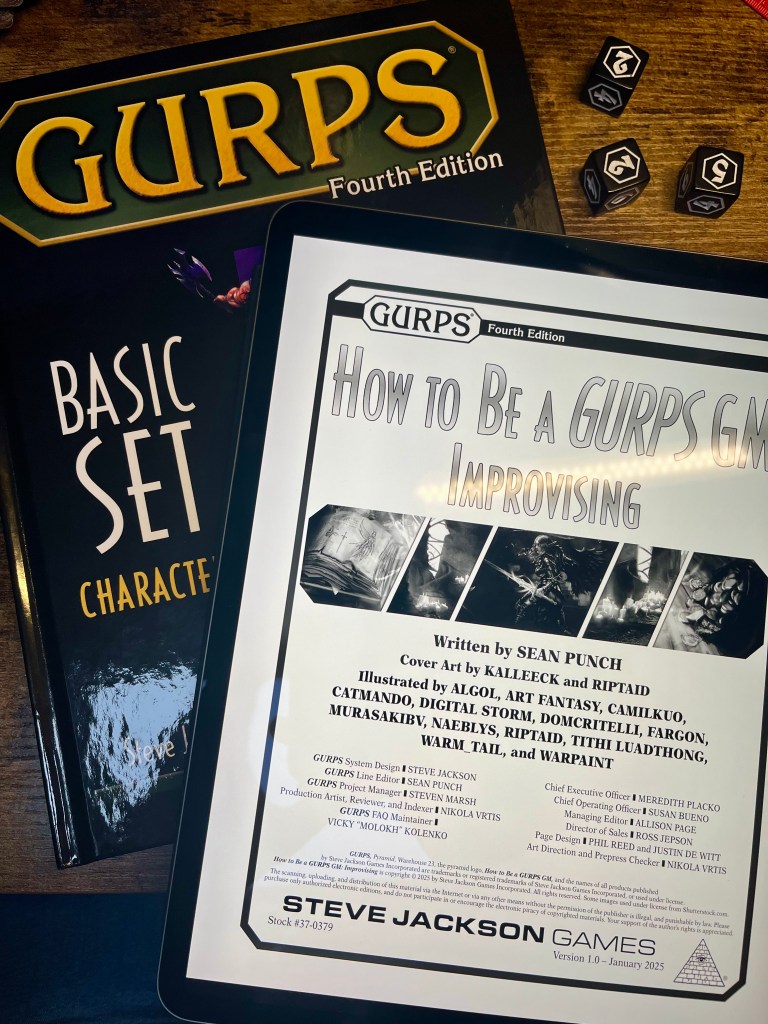
For the past year or so, I was improvising most of the sessions of play in Fellmyr around some basic building blocks. Yes, I was doing prep but it was minimal and provided a basis for more improvised elements to arise in play. This style was more enjoyable for me as GM because it provided surprises at the table as well as making prep endurable.
Playing Call of Cthulhu in recent weeks was the converse: running pre-written investigative adventures meant long hours of reading, fumbling my way through someone else’s (poorly designed) scenario, and being forced to improvise anyway. It has been a sobering reminder of the way in which the market of pre-written adventures does a generally poor job.
There is some balance to be found for each individual GM. If you are time-rich, find it easy to grok pre-written material, can analyse and fix the problems in a scenario with ease, and enjoy using ideas from other people then the market is full of good stuff. If, like me, those things are untrue then dialling up improvisation is a good choice.
Except… for the anxiety that I have had to manage due to the inherent uncertainty that improvisation implies and in fact creates. No, you don’t know what will happen at the table and that’s both the joy and the challenge of this approach. What I have discovered is that the kind of advice in SJ Games’ latest .PDF is a way to manage that tension.
The core idea to internalise is that improvisation doesn’t mean playing with zero preparation.
Improvisation is really about being ready to adapt on the fly in the spirit of GURPS’ “When in doubt, roll and shout” outbox advice on B497. What I found with Fellmyr is that having sketched out a simple map of the territory and defined some basics, improv was more fun than detailed prep.
Whatever you do, it’s a good idea not to let the players know when you are improvising. Let them think you had it all planned in advance.
My players know that I improvise… at least sometimes. The trick is to cloak when I am improvising. Sometimes I have forgotten this advice and I think that it does cheapen the experience when the illusion of pre-created reality is broken. Asking for a random roll to determine an NPC’s name from a random table is an example of my poor practice here.
I’ve a strong sense that whether I prep something specific or it emerges from play improv-style it doesn’t much matter if the guys are enjoying the experience. Sometimes contradictions arise when I operate on the fly but this just adds to the mystery and good players will start to use abductive reasoning to resolve the paradox. This is fun.
All of this sits side-by-side with my desire to play GURPS with a more stripped-down and minimal draw from the Basic Set. Recent tinkering with trying out Wildcard Skills (B175) to shorten the skill list, opting for lower-powered characters (circa 100 points), and running things with a select set of Advantages and Disadvantages to begin with all fit this approach.
As I’ve said before, I want the structure and support of a solid set of rules. But I don’t need an overly precise set of wargame-style mechanisms; instead, I favour an accurate set of rules that approximate the imagined reality of the secondary world in support of my common sense of what might happen if the character tries this or that.
I want to play the world and see the players explore their characters in that fantastic place. I am not driven to provide plot or story, rather to see outcomes emerge from the act of playing. I want to be more like my child-self playing with my mates in the sandbox and making stuff up as we riffed off each other. Rules help us adjudicate when we don’t agree.
I think I am ready to improvise from the ground up. Sitting down with a group of players and conceiving the basic parameters of the game we seek to play collaboratively, going away to build some basic elements – such as a play space (the “sandbox”), people (NPCs), and an initial situation – is enough. I can let the remainder emerge in play and in Tiny Prep between.
Game on!
 Roleplay Rescue’s Blog
It’s delightful to read these notes showing how preparation for improvisation is revealing itself as satisfying and useful to you.
People I speak with about gaming often balk at aspects of Improvisation, such as the fear of having nothing to say in a given moment, or the problem of having decision options collapsing only to reaction from the broader spread of action, reaction, and interaction. These, as you have been showing in your reporting of your own experiences, are balanced by the preparation aspect, which is shaped by the needs of the group, the game, and the evolving understanding of the GM for the group and game over time~
LikeLiked by 1 person