
Reading the various blogs and books, or consuming the myriad of podcasts and videos out there, it’s easy to believe that there are competing tribes of roleplayers who each preach the “One True Way”.
My problem is that I do not easily fit into any of these tribes. My personal preferences lie outside the mainstream, certainly, but also they cross the streams in a way that some say is dangerous, or at least “Bad Wrong Fun”.
Firstly, I don’t much like the assumptions I find about roleplaying games. Secondly, having encountered the proselytes for each tribe, I don’t much enjoy the tone of discourse – which is increasingly simply shouting to one’s own tribe about how bad every other tribe behaves.
But putting all of that aside, the biggest problem for me is that I enjoy more than one stream of roleplaying. Certainly, I have a preference for what was once proudly called ‘simulationism’ before it got branded as a fool’s errand.
But even within that label, I find myself with three types of simulation: the Regular kind, the Wargaming kind, and the Otherworld-immersed kind.
Regular Simulation
This is my label for the “regular kind of game” which has grown out of Dungeons & Dragons roots but remains focused on simulation. It’s the kind of game that my own Fellmyr represents: there are faux-medieval towns and cities, village adventurers, ancient places filled with untold treasures, and monsters to protect them.
This is the Modernic Fantasy that I’ve discussed with Daniel Jones but perhaps dialled back towards the TSR days of Dungeons & Dragons, inspired as my own Fellmyr has been by Basic D&D (1983), aka BECMI. It’s not concerned with historicity or even great depth in the World, but rather the simulation is sought in the relatively grounded rules.
This type of game contains dungeons, certainly, but also urban adventures and wilderness expeditions. In my version, the player’s agency is paramount and the role of the GM is in designing and generating the World to challenge the choices of player characters. Rules are visible and characters can be deeply drawn.
Wargaming Simulation
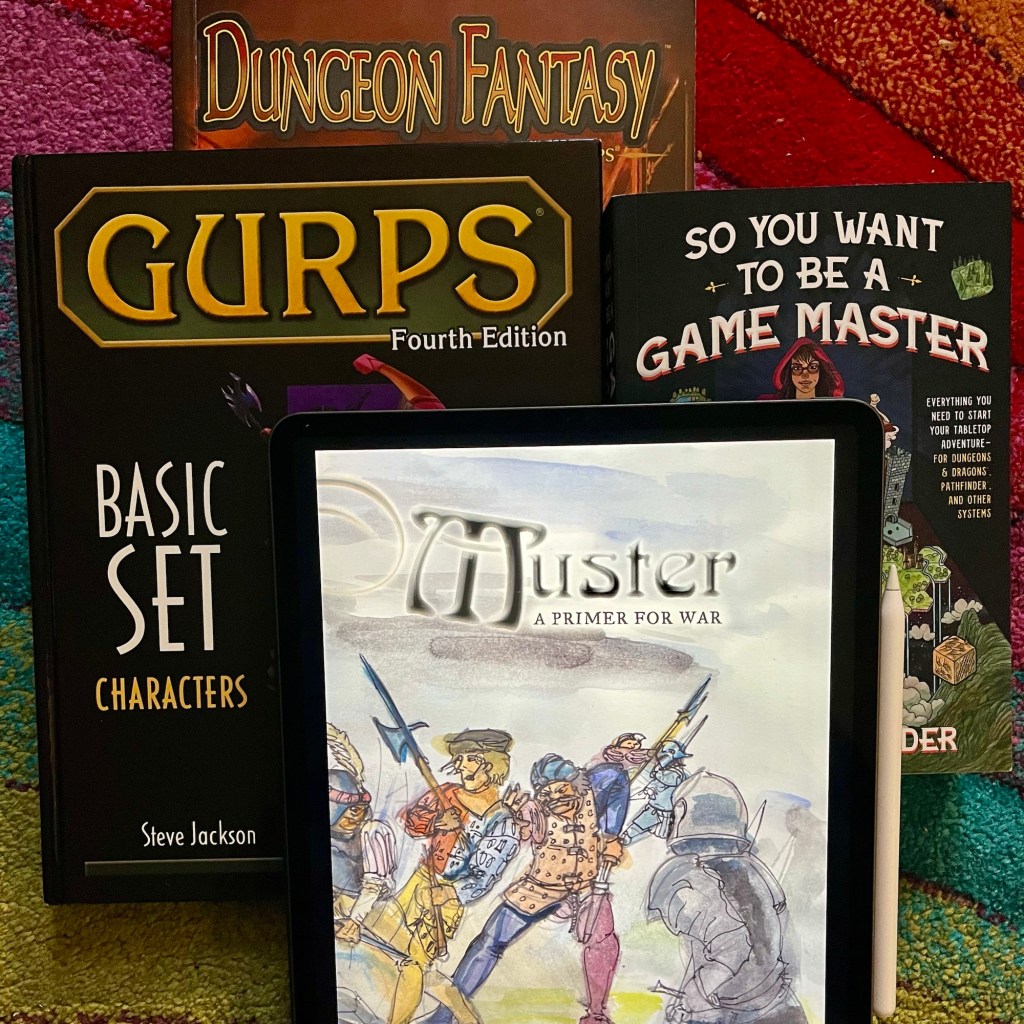
Recent discovery of Eero Tuovinen’s “Muster” pointed me back towards this taste that I hold, that of the “wargaming way”. Of course, it is also the play that emerged prior to the publication of Dungeons & Dragons more than 50 years ago. I first explored it when I read Jon Peterson’s “Playing The World” and watched “Secrets of Blackmoor”.
Speaking of this way, the basics are focused on the Megadungeon concept and the core play cycle of exploring such vast underground locations. These are perhaps more a type of Mythic fantasy, cyclopean depths with treasure and monsters which test the mettle of the brave or foolish.
This approach strips the character down to a handful of mere numbers, equips the erstwhile pawn of the player with useful items, and sends him out to probably die. The style is big on player skill and group cooperation, low on characterisation and play-acting.
There is (often) an appeal to D&D originalism here which I find jarring but the basic idea – of a deeply fantastic underground realm wherein fortune can be found – is simulated with the barest set of rules and the Referee is subject to the ideal of the group being challenged as they pursue their own agenda.
The main distinction is that the wargame roots of D&D are emphasised, usually in opposition to what is seen as upstart attempts to turn D&D into a story-telling activity. For my tastes, this dials the play towards the tabletop wargame roots in my own experience – especially the hex-and-chit games I enjoyed with my father.
Thus, I like to play a wargaming simulation with miniatures or tokens on a battle map. Preferably that’s a hex map, although I love 2D terrain and 3D terrain even more because of the visual and tactile appeal. My detour in this type of roleplaying game is through the way of more detail in the combat rules because it’s a wargame first and foremost.
Otherworld-immersed Simulation
Thanks are owed to Daniel Jones from Primaeval Fantasy for the terminology and methodology for playing in a more Otherworld-immersed style. That is to say, where fantasy realism and the World itself are paramount.
The goal in this kind of game is to immerse oneself in both the character and the World played within. You seek to marry the perspective of the character with your own. This means you need a deeply believable and realistic simulation of both character and World.
Gone is the Modernic fantasy of D&D, swept away by the lowering of the power curve and the desire to emulate pre-Modern assumptions and patterns of thought. This is escapism dialled towards the imagination, away from power-fantasy towards the desire to feel and experience the Otherworld.
Methods of play include moving the rules behind the GM screen, even taking character sheets out of the view of players. They have the description only, plus their naturalistic understanding of regular physics. Discovery of the magical and spiritual truths of the World must be done through play.
To me, this is the higher form of play because it places the imagination – what we experience in our minds – at the pinnacle of the game’s purpose. Higher not in hierarchy but in importance to me because while I love a good battle, and I can have fun in the regular realms, what I deeply desire is the Otherworld-immersed game.
But that said, I enjoy all three in roughly even measure. There is bleed-through from the Otherworld-immersed game, certainly, in that I can no longer stomach the gonzo and unjustified mish-mash some players enjoy. I desire simulation, not cool stories nor neat little rules.
Three Fantasies
All of which is to say that I am moving towards providing three fantasies, all powered by variants of the same game rules, each with a different emphasis.
At one end stands the Open Table Megadungeon and the other end is rooted the Otherworld-immersed Dedicated Table. Between is Fellmyr, that Regular Simulation which can open a doorway in-between.
Which says little about my offer for Science-Fiction gaming nor for Modern-world adventure, except to say that it will probably be simulationist and informed by these three styles here outlined.
I don’t think you have to choose one tribe and sit inside it. I believe that travelling between the camps opens up more opportunities for play, exploration, experimentation, and playfulness. I certainly don’t want to spend time fighting over my hobby or being denigrated for my harmless tastes.
Game on!
 Roleplay Rescue’s Blog
Good.
This sounds like an effective way to explore and create Fellmyr, an efficient use of your time, a practical way to connect with your play groups, and have fun.
We all end up finding a personal set of best practices if we are the sort to look (and have the opportunity to do so) but we don’t have to restrict ourselves to them. Tastes change in mysterious ways over time.
As for a One True Way…? Hilarious~
LikeLiked by 2 people
Another fantastic and thought provoking post! It seems every hobby has to have a small but highly opinionated and very loud minority telling everyone that ACTUALLY everyone else is doing it wrong. The “One True Way” lot are ours, although at least it’s entertaining watching them argue over which “true way” we’re all supposed to be following. It’s a shame that there are probably people out there who aren’t playing the game they’d actually like because they think it’s supposed to be done a certain way.
I’m running an open table Knave game at the moment, exploring a mega-dungeon and uncovering the secrets of the nearby town, which incorporates several styles at different points. Something I tell new players (and since I’m the only one at the store running an open table, I get a lot!) early on is that this is just how I run a game. If you like it too, stay at my table as long as you’re having fun; if you don’t, no hard feelings at all, it’s not for everyone and that’s fine! I’m always happy to recommend other games with a different feel if they’d like to try something else.
LikeLiked by 3 people
[…] I mentioned this the other day, my physical copy of “Muster“ by Eero Tuovinen arrived and it’s a far more chunky […]
LikeLike