
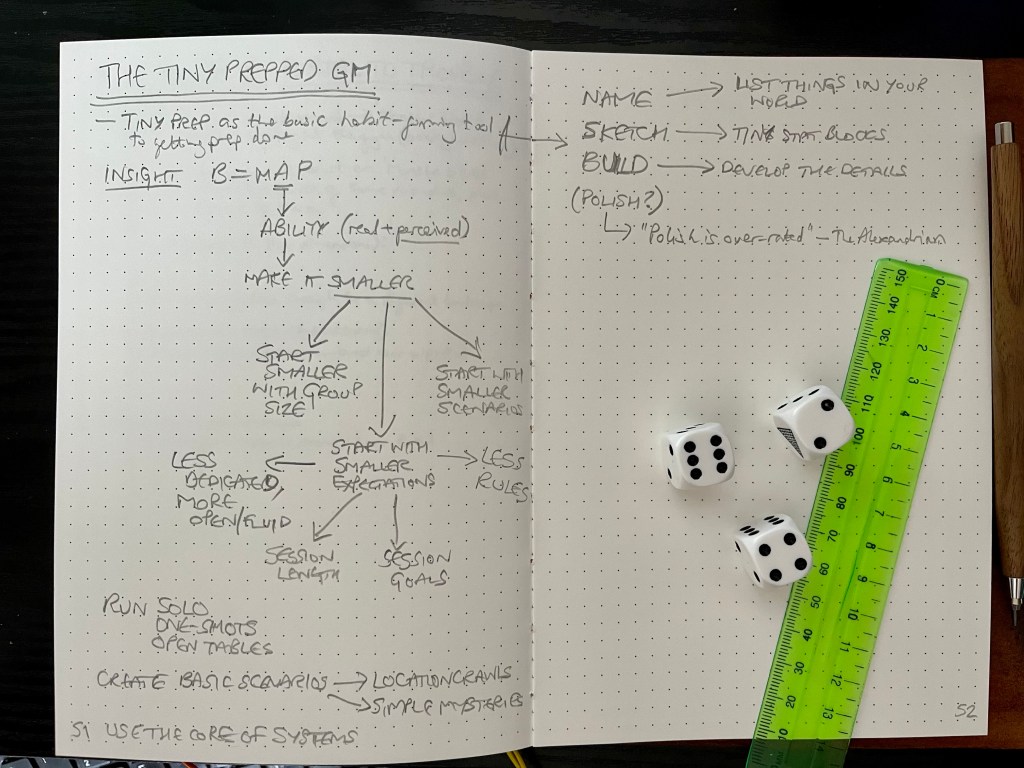
Today, I had another breakthrough with my Tiny Prep to talk about. In my Daybook (a notebook I use for daily ideas/reflections), I scribbled down some rough ideas around becoming a Tiny Prepped GM (see second image) so this is early thinking.
For the uninitiated, Tiny Prep is the simple idea of doing your GM game preparations in very small increments daily. Tiny Prep was inspired by the work of BJ Fogg, the Director of the Stanford Behavioural Lab and discussed at length in his highly-recommended book “Tiny Habits”.
For the curious, I wrote another article introducing Tiny Prep back in January 2023, entitled “Tiny Prep“. It outlined how I did it back then but I’ve been using it and developing the idea since early 2020 and there are other podcast episodes and blog posts talking about it.
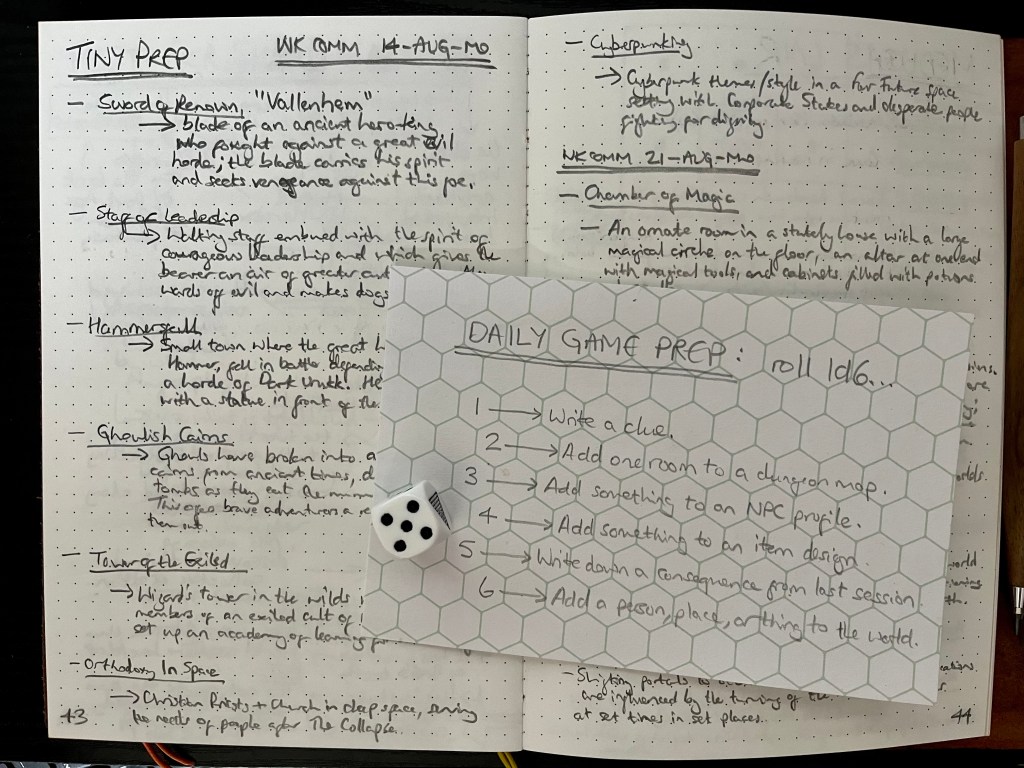
Here’s a quote from the book that I am writing (yes, really) entitled, “Tiny Prep”:
When you don’t have a clue where to start your Gamemaster prep, the trick is to start small. No, smaller than that. Smaller. Tiny, even.
That quotation sits the root of how I am approaching GM prep generally at the moment. In other words, everything I aim to do seeks to ask, “What’s the smallest meaningful and smartest prep I can do for this game session?”
This helps in at least two ways: firstly, I feel less pressure and stress around GM prep, which helps me overcome the procrastination that arises from fear; secondly, I enjoy the prep more and come up with more creative ideas, simply because I am not locked in a cycle of anxiety.
Tiny Prep = Smaller, Simpler Prep
Being focused on the Ability part of the Fogg Behaviour Model, I’ve begun to realise that Tiny Prep is not limited to simple and very small acts of creativity. Make things smaller (so that they are easier and I feel able to do them) means that I can also consider several other aspects of GM prep to shrink, for example:
- Start with a smaller gaming group
- Start with smaller expectations about the game
- Start with smaller scenarios
Thinking about running a dedicated campaign for a group of six players is a big scary expectation. I had far more fun when I chose to shrink my group size to two players, decided we would just start with prepping and running one adventure (even though we’d like to do more), and decided to run a small 5-room dungeon.
From there, I realised that running a solo game just for myself is a good way to start learning a new game. Run just a small combat scenario if even that sounds like too much. I had loads of fun and ended up running two combat scenarios solo. This gave me confidence to try a different genre of play.
Now I am prepping a simple single scenario for my two-person gaming group in the Urban-Fantasy / Alternate Worlds genre. Again, the goal is one adventure (over a few sessions) prepped with a simple scenario structure (I’m sticking to Locationcrawls and Mysteries for now).
Fewer rules (just core GURPS), shorter session length (2.5 hours), smaller group (2 players), simple scenarios run episodically. All of this is about shrinking the perception of GMing a dedicated campaign to be more fluid and flexible. If we don’t like the first adventure, we can shift gears and try a different approach.
Tiny Prep is a principle about making your GM prep more doable. I’ve found great utility in the basic habit-forming stuff I talked about before but now I am adding approaches to overall prep and campaign building.
The easiest group-based Tiny Prepped campaign would be to start an Open Table with just one or two player seats per session playing Locationcrawls. You could even build a megadungeon one 5-room dungeon (or small section) at a time. Any mission-based scenario structure would be fine: one Tiny Mystery, one Tiny Dungeon, one Tiny Hexcrawl.
I’ll keep you informed on how things work out.
Game on!
 Roleplay Rescue’s Blog
I like the thought of tiny prep, and I read your previous post (possibly even discussed it in my blog).
But I have come to realise my biggest hurdle is getting started, and once I’m going things seem to flow. So if I was just doing something tiny every day I’d worry I’d be hitting that hurdle and then not capitalising on having overcome the initial inertia.
LikeLiked by 1 person
I can relate to that. I think you’ll find that, if you have the time, you get started with the Tiny Prep habit and it can quickly become a longer period in the zone of writing / creating each time.
LikeLike
Getting started. Inertia. That is a problem. I love these articles. I think the key, besides realizing that breaking things into smaller, achievable parts is critical, is understanding that Motivation is not the key to success in a lot of endeavors. The brilliance of this model is its acceptance that Motivation comes and goes. It is the practice and habit that is important. Doing the thing even if you are tired or unmotivated. Seems simple, but it is profound.
LikeLiked by 2 people