
Back in the early Nineties, I remember buying ‘The Forgotten Realms’ campaign boxed set. I was curious about the setting and, when I opened it, I remember being drawn in by the colour maps. Fast-forward to 1998 and I was arriving in Nottingham, meeting a new friend who was to form the bedrock of the Friday Night Roleplay group for the next 22 years.
Ian was big into D&D 2nd Edition and, as we moved into the 3rd Edition in 2000, we returned to the Forgotten Realms. Why? Because the Forgotten Realms was the official default setting for D&D 3rd Edition. But (don’t worry) this is not really a post about Dungeons & Dragons.
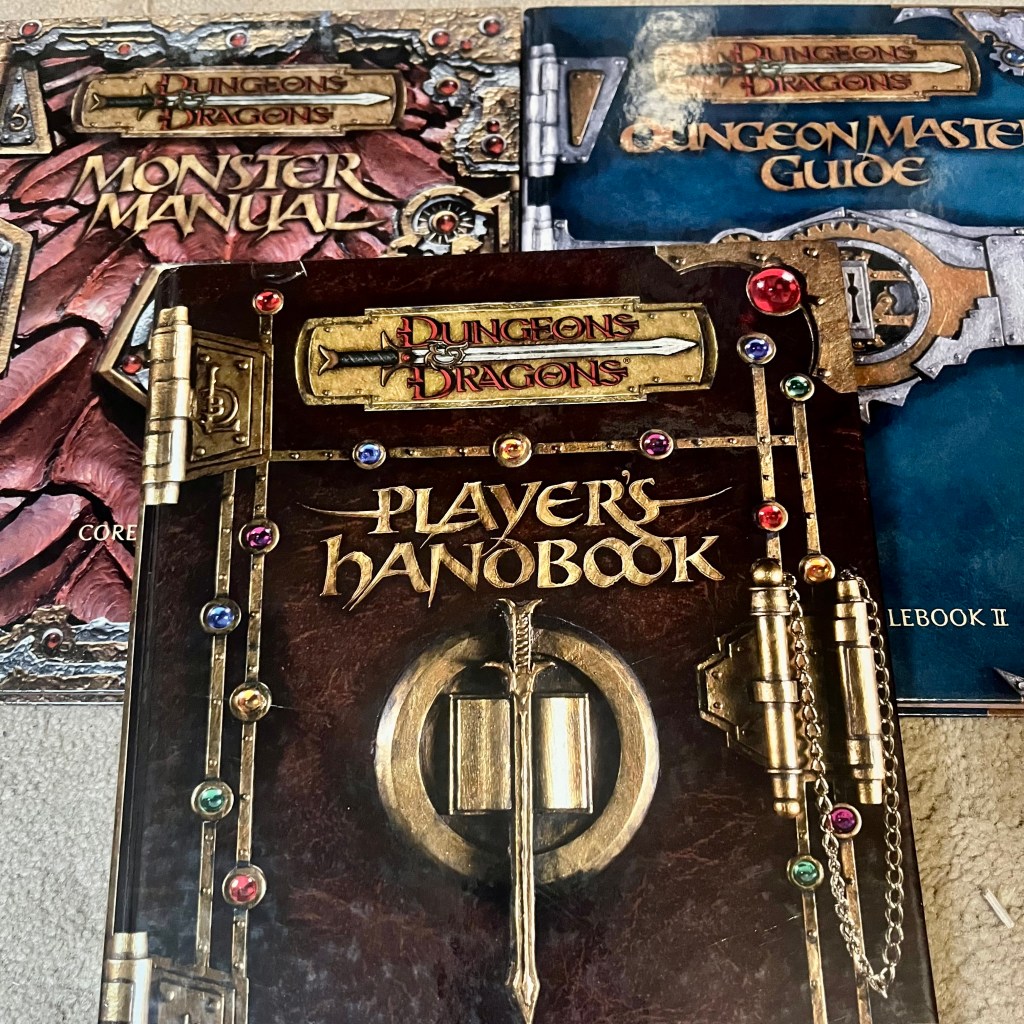
As the primary GM for the group as we learned to play 3rd Edition D&D, I wanted to run a campaign for my friends in the Forgotten Realms. The problem was that by this point, TSR and Wizards of the Coast had published in excess of 140 modules and campaign books for that setting.
I think this was the first time I remember feeling the sense of overwhelm and anxiety about running a game in an Otherworld that has a massive quantity of lore. Through the years, I’ve wanted to run games in many other settings with this problem, from Glorantha to the Third Imperium.
Until relatively recently, this sense of overwhelm and anxiety – let’s call it what it is: fear – stopped me in my tracks every time. Sometimes I would begin, play a few sessions, but in the end the fear of not knowing enough would stifle my confidence and drive me to jump game.
But there was something I didn’t realise then that has helped me move past that fear now. The simple truth with roleplaying games is that the player characters do not play the whole Otherworld. They play in one particular place and one particular moment as they move through that world.
All you need as the GM is a clear sense of the Where and the When for your game.
With these two concepts, you can ground yourself in what you need to prepare. You don’t need anything more. Your players certainly don’t need more because, if they are going to be looking through the eyes of their player characters then they can only look at one place at any one time.
My first game in the Forgotten Realms was originally set in Daggerford in 1356 DR (Dale Reckoning). I had the ‘Under Illfarn’ (N5) adventure and the boxed set. This was more than enough to get a game off the ground. But I allowed myself to get distracted by the idea of canon.
When I came to set up Karameikos last year, I was wobbly about playing a game set in the old D&D setting of Mystara because I was aware that there are maybe 78 published books, boxes, and adventures related to that Otherworld. But I remembered the maxim above.
All I needed was a Where and a When.
My Karameikos campaign began in Threshold in the year 1000 AC (After Crowning). I had the Basic/Expert books from BECMI D&D, GAZ 1 Karameikos, and B10 ‘Night’s Dark Terror’. That’s what I focused on as a set of references for the Otherworld. Yes, the rest was there but this was enough.
To create characters, my players didn’t need a book of lore to read. They didn’t even need me to summarise it for them. To recruit the players at the table today, I simply pitched the game with two paragraphs: one was on Karameikos broadly; the other was on Threshold. The characters the guys created are original and fabulous. They fit that Where and that When perfectly.
We’re seventeen sessions deep in Karameikos. We’re not playing with D&D, of course, because that’s not my jam, but we are playing within the broader Mystara setting materials. My approach has been to hold the lore lightly: if it doesn’t fit the vibe I want for my game, it gets ejected; otherwise, I do my best with what I have session-by-session. My Karameikos does vary.
Want to play a game in a world that has a truck tonne of published books and complex lore? Great. Ignore it: all you need is a clear sense of the Where and the When for your game. Pick one location. Specify a point in history within that world. Create the game from there.
When we play session-by-session, in-character as-character, within a specific Otherworld, our players only need to know what their characters know. They can only be in one place at a time.
Prep for the next session, focus on describing what their PCs might encounter, and let the rest of lore sit on the shelf ready for when (and if) you ever want to reference it. You certainly don’t need it.
Game on!


Same issue with Traveller – decades of universe building. Which I tend to mostly ignore and just pick out the pieces that fit my game. Which is what you suggest: “My approach has been to hold the lore lightly: if it doesn’t fit the vibe I want for my game, it gets ejected; otherwise, I do my best with what I have session-by-session”
LikeLiked by 1 person
Heh, yeah, I run into that problem a lot, because I love games with really tons of deep lore… but then I feel like I’m running the game wrong because I haven’t read the literal hundreds of books written about it. Mostly I try to set the game in some corner of the setting that hasn’t been detailed and stay away from all the canonical NPCs. Which does rather remove the whole point of running lore-rich games, but, well, it’s what works for me.
LikeLike
Love this insight! Same advice stands even with Homebrew worlds. Like many other DMs and GMs, i am tempted to write lots of lore: struggles among the gods, lost kingdoms, terrible downfalls, Cities far off – and the web of current political Court intrigue. But I have finally learnt to focus on the Where, When, and the Here and Now. That’s all that is going to directly affect the campaign right now. While Factions have their place, do you really need to know the progress of their ongoing struggles right now? Yes create the new piece for the new campaign, but you don’t need to “put it on the board” until the Adventurers encounter it – either directly or through rumour. Until then, leave it – you have plenty enough to do with preparing their current Dungeon!!
LikeLike