
Why is it that, even when we have done the prep and know our Otherworld inside out, stepping into the shoes of the people who live there can sometimes feel like pulling teeth?
We sit at the table, notes in hand, yet the moment we have to speak for the starport official or the local merchant, a strange, creeping exhaustion sets in. For years, I assumed this friction was simply my own anxiety making the act of “performance” feel like walking into a firing squad.
But what if the problem isn’t our anxiety, and it certainly isn’t the people who live in the Otherworld? The problem is the expectation that we are supposed to be actors putting on a show. Acting implies we have to be perfect, that we have to memorise lines, or fake it as improv masters. For me, the breakthrough came when I stopped trying to perform and simply started visiting the Otherworld.
Enter the mask of the Sojourner.
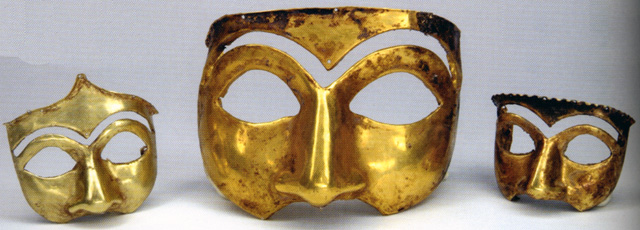
To sojourn means to spend a short period staying in a particular place. When I step into the role of a person living in the Otherworld, I am a temporary traveller inhabiting a role. I step into the mask, play out the scene, and then step back out into being either the Scout or the Sentinel. The mask is not a lie, but rather a vital shield that protects my socially anxious mind. It creates a safe distance between my vulnerable self and the social pressure of the table. But it also allows me to inhabit that persona.
Because I am visiting the Otherworld, it completely stops the emotional bleed from my own insecurities. If I need to play a grumpy, suspicious starport official who is acting as an obstacle to the players, I can be bold or dismissive. I know that any anger the players feel is directed at the mask, not at me. I do not need to be an improv master or invent that official’s childhood trauma on the fly. I simply focus on their immediate goal and their reaction, giving them the dignity of being a real person for a few moments, and then I take the mask off.
At the most basic level, I can wear this mask on the purely surface level: what the player characters see and hear. Because, in the real world, what we know of another person is limited to what they do and what they say, it doesn’t matter when the PCs are meeting that new person in the Otherworld for the first time. If I am unprepared, I slip on the mask – thin though that might seem – and show them what the person is doing, speaking their words in that situation. If a character has been reoccurring in the Otherworld, then I can layer in more prep as I need it. We go only as deep as we need.
But there is a catch. The mask of the Sojourner only fits comfortably if everyone sitting around the table is actually trying to play the same game.
If you are putting on the mask to facilitate high-fidelity Otherworld-immersion—treating that starport official as a real person in a living, breathing place—but your players are treating the session as a mechanical puzzle to be beaten or a narrative story to be “won,” the friction returns. The mask slips, not because of your anxiety, but because your foundational assumptions about the game are mismatched.
As my GURPStalk podcast co-host Pat recently pointed out, the greatest separator in our hobby isn’t about which game system you use or which genre you prefer. It is about the underlying goal for play before you even sit down to roll the dice. Because I want to offer (and experience) role-play in-character as-character, a player who isn’t coming at the play from this angle will radically tear the mask from my face.
If you play from the in-character as-player stance—that is, if you are trying to roleplay as if you are your character, but your mind is on the mechanisms of play and the fact that you are a player in a game—then you are going to affect the way I and all the other players inhabit the Otherworld. Example: you want to find out something from the scene you are in, so you ask the GM if you can roll your Search skill. In that moment—bump—we’re back in reality and we’re just playing a game.
As a player, you need to give me a clear statement of action and intent. Searching a room in an apartment? Tell me you’re (as in your character, but in-character, first-person) going to walk around the lounge and try to see what’s there beyond the obvious: anything unusual lying around? As GM, I will adjudicate in Sentinel mode by rolling your Search skill (in GURPS, anyway). Then I’ll let the Scout tell you what you notice.
One thing I’ve noticed is that—as a person who GMs most of the time—it’s easy for me to forget to wear the mask and sojourn when I’m a player. I find myself looking to the character sheet and thinking about skill rolls because that’s the role I usually spend most of my time inhabiting as GM: the Sentinel. But the player has no place taking on the Sentinel when they are roleplaying in-character as-character. At best, they can assist the GM if they are asked. But really, if we share the goal of Otherworld-immersion, we need to play in-character as-character as much as possible.
So, whether you are running the game or playing in it, the goal remains the same: keep the mask on, trust the Sentinel to ground the Otherworld using the rules, and just enjoy the visit. When the whole table shares that desire to inhabit the secondary world, the friction vanishes, and the Otherworld truly comes alive.
Game on!


Posted on the Discord already, but this inspired me to design an Ars Magica enchanted item:
**Mask of the Sojourner**
Muto Mentem (Imaginem), level 34
Not satisfied with merely changing his appearance, the magus Webster ex Merinita decided to enchant a mask that would enable him to truly embody a different personality. This mask, when worn, transforms the appearance and voice of the wearer (also concealing the mask, though it can still be felt), but more fundamentally it rewrites all of their memories. For as long as it is worn, the wearer has an entirely different “life story” and will not remember their true life (this can of course cause problems, if their new persona doesn’t find a reason to remove the mask).
[Showing my working: Muto Mentem Base Level 10 (for rewriting a target’s entire memories), +1 Magnitude for Touch range, +2 Magnitude for Sun duration = level 25, +1 magnitude for the Muto Imaginem effect (by itself, level 5) = level 30, +4 levels for two uses per day, triggered by sunrise and sunset = level 34]
LikeLiked by 2 people