
This week has been focused on Fighting Fantasy as an RPG, an idea that certainly dates back at least to 1989 for me when I read “Dungeoneer”, but perhaps earlier when I was playing the Fighting Fantasy game books and feeling like they didn’t quite hit the spot. The missing element was the sense of freedom that comes from a true roleplaying game.

Which brings me to insight from Runeslinger’s recent YouTube video about the medium of the RPG being conversation. I think I accept this as basically true but it raised the question of whether a solo game was in fact an RPG if it did not include conversation. Can you have conversation alone?
On reflection, I think that in my solo play the answer is yes: I am essentially switching between being Player of the character(s) and being the Describer of the World and the Adjudicator of the Rules. I have always, ever since my youth, spoken to myself out-loud when solo playing; at the very least, the act of typing out or writing out my thoughts in-play and live acts as a quieter proxy for this conversation.
Reflecting on the solo experience as having, as Jamison might put it, the different roles of the GM broken down into “Camera” – which I prefer to think of as the Describer because camera feels too visual and excludes sound, smell, and touch as senses – and “Judge” or Adjudicator, I am not quite sure how I implement the GM role of “Actor” to play the NPCs.
Where the GM Emulator comes in is both to help decide the reactions of NPCs and to decide what might be present in the World to Describe. The main point, of course, is that there is a dialogue – the conversation – which is happening internally, much as I experience such dialogue internally daily in my experience of life.

Back to Fighting Fantasy, I am drawn to the extreme simplicity of the 1984 book: three statistics, SKILL + STAMINA + LUCK and then the use of odds rolled on 1d6 for other questions, such as whether the trap is triggered.
I’ve been paralleling this model in my mind with GURPS and asking myself what the minimum level of simplicity I might enjoy could be. One of the most notable elements missing from Fighting Fantasy in 1984 is any kind of either “Special Skills” (as they are called in Dungeoneer) or “Classes” (as they might be known in D&D). There is only the generic adventurer with a sword. This reminds me of the set-up for the Dungeons of Thaarl: they were all non-magical mundane human adventurers.
Thinking about introducing newbies to the game, one of whom likes the idea of playing a “Barbarian” in the vein of Conan, I was drawn to the idea of the use of a kind of Tag, “Barbarian”, to allow the character to do the kinds of things that only a Barbarian might do. This only has meaning, however, if there are different foci for adventurers in the game: Wizards, Thieves, Dwarfs, Elves, whatever.
Is variety of type necessary, no. Is it desirable? Probably. But Fighting Fantasy, initially at least, provides variety only in the random roll of the dice for your SKILL, STAMINA, and LUCK.
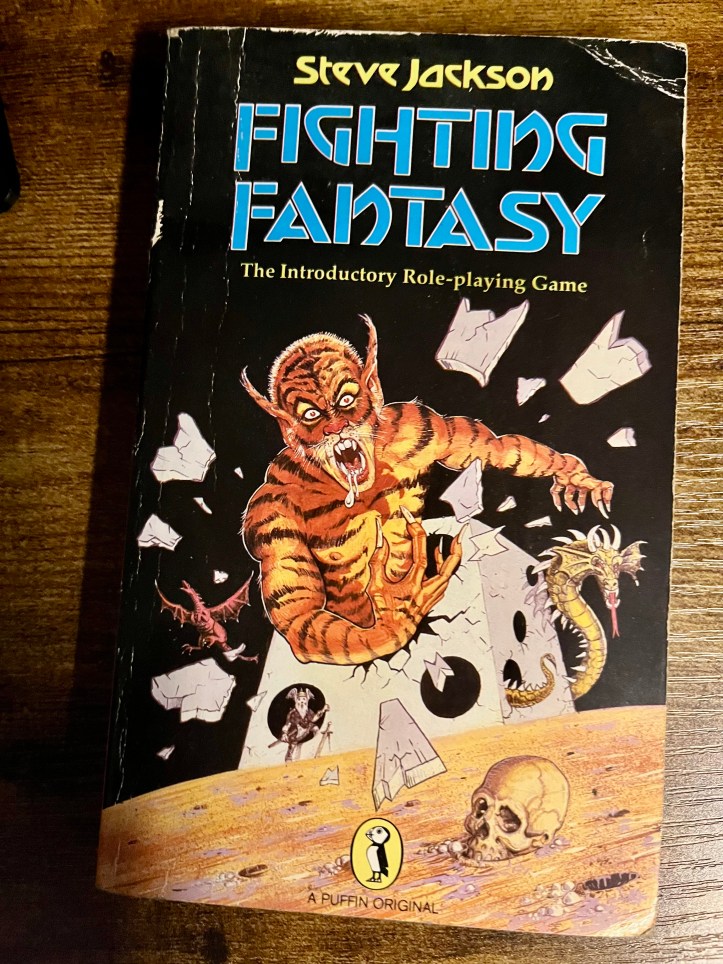
Another reflection from revisiting Fighting Fantasy has been the recognition of my preference for the aesthetic of the 1980s versions of that game. I have Arion Games’ “Advanced Fighting Fantasy” but I find the aesthetic turns me off: layout, artwork, format of the books is all undesirable.
The content of AFF is almost identical but the aesthetic of the 1980s collection engages me and excites me in a way that Arion’s attempts leave me stone cold. This applies less starkly to other games, such as GURPS Third Edition versus Fourth Edition, but the effect is similar: I prefer the aesthetic of the earlier GURPS, earlier Rolemaster, earlier D&D, earlier Warhammer, earlier almost everything. It’s not simple nostalgia; it’s the aesthetic.
The question is what do I do with all of that? I think I would do well to start a game using the minimal presentation of the Fighting Fantasy game – or the equivalent most-stripped version of GURPS – and see how the “mere adventurer” with their SKILL, STAMINA, and LUCK feels at the table.
I’d like to try this with other players ideally, because RPGs as operating in the medium of conversation are stronger with a few more voices, but I can easily make a start solo. My prediction is that it will be enjoyable for a while but the lack of variation and progression options will wear thin over time in a campaign. But, as with all predictions, it is best to test them lest we fall foul of the cognitive biases that we hold without proving them through experience.
Game on!
 Roleplay Rescue’s Blog
In regard to Fighting Fantasy players accepting the role of the fighter you describe, it strikes me that this is a similar choice that we are offered in early Pendragon: play this, just this, not those other things. It can seem compelling if we like the thing being offered, and less so with other preferences.
Every once in a while, however, I make pre-gens for a short series of sessions of some game or other which are identical except for the names. I am more likely to do this when we are learning a new system, but not always. It is interesting and exciting how quickly these identical numbers become different people with similar capabilities. If we end up liking those people and playing longer than expected, the change in capabilities is of additional interest~
PS: Thanks for sharing the link to my video!
LikeLiked by 2 people
I have certainly had experience of playing with very basic / limited statistically similar characters and noticed that each individual player tends to personalise their character in a very different manner. Perhaps there is an illusion in the idea of characterisation being grounded in the rules.
LikeLiked by 1 person
Or at least room for interpretation~
LikeLiked by 1 person
[…] recent days I have travelled back in time to 1984 and explored Fighting Fantasy, then on into 1985 to explore Dragon Warriors. I took a brief turn back to GURPS and worked a […]
LikeLike