
One of the biggest reasons that I have been excited about my delve in GURPS Third Edition has been the realisation that there are so many worlds to explore. From the specific world books – like Cyberworld or The Prisoner – to the genre guides such as Space, there exists a panoply of possibilities. Even more than that is the opportunity to mash stuff up.
I’m a self-confessed explorer of worlds, preferring to both act as a Player who enjoys discovering the secrets of any given setting and also perform as a GM who provides interesting places for others to roam around in. The renaissance of GURPS books offers me an endless range of elements to mess around with.
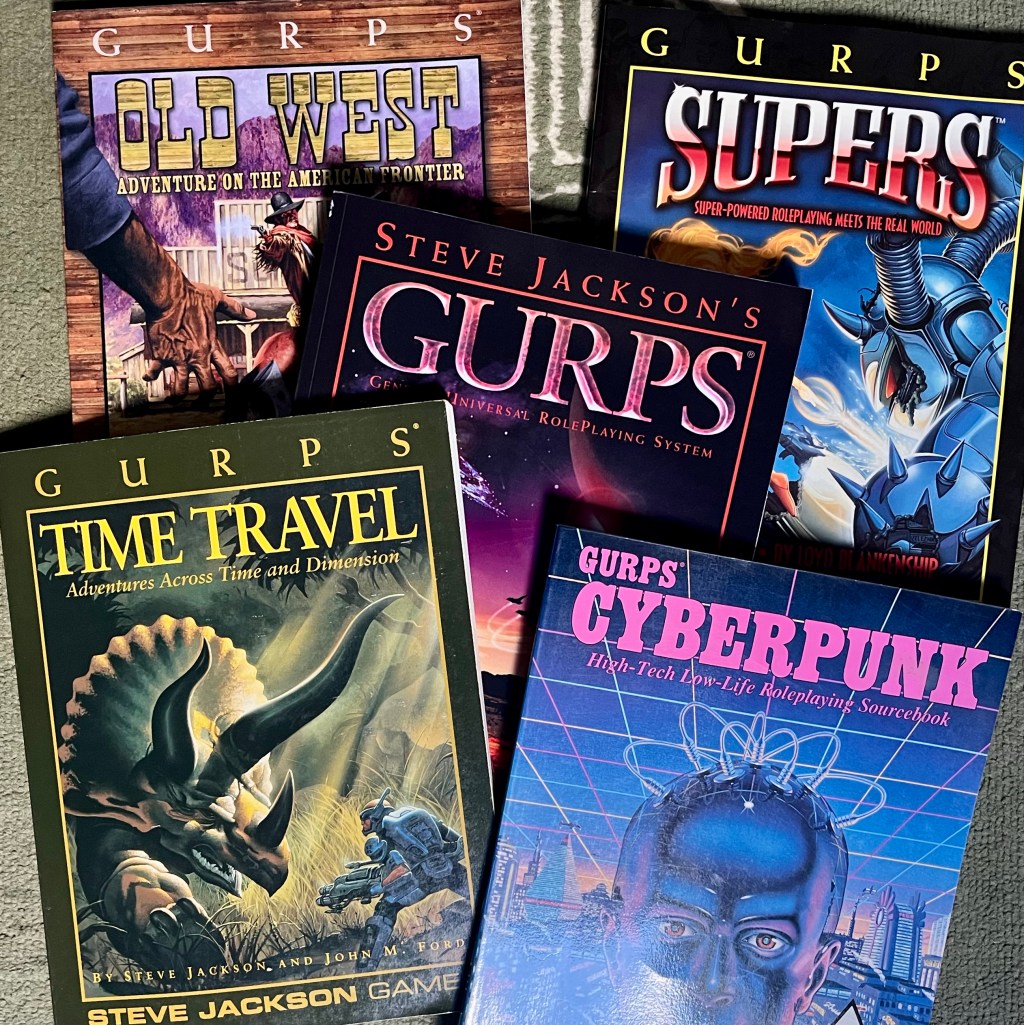
And so I face the dilemma that my ADHD mind cannot reconcile: which of these possibilities shall we begin with? The best option is probably to simply pull a few books off the shelf and then either randomly choose 2 or 3 with which to perform a mash-up, or allow my intuition to pull me in a single direction.
The strategy that has worked well with other games in the past has been to focus on allowing myself space to play alone. Whether it’s to nominally permit myself to play solo or just to imagine a world I might offer other players, the act of giving myself time to explore is key. Without, I’ll just hover around wondering where to begin.
Perhaps sketching out a series of one-shot adventures in a given imagined world is enough to allow some exploration of the possibilities. The idea of having a bank of pre-prepped short adventures I can deploy at the school club or with friends (online or face-to-face) appeals greatly.
If nothing else, the act of creation helps me to explore the system and figure out how I might deploy different facets of the GURPS engine to solve the needs of multiple worlds and scenarios. Because it’s a toolkit, the application of relevant rules options to specific game situations is a sure-fire path towards system mastery.
Game on!
 Roleplay Rescue’s Blog