
An “RPG that is easy to use” seems an odd category to invoke given how all RPGs are essentially formed around the same basic dialogue whereby the GM describes a situation and the Player declares an action in response. The “easy to use” presumably refers to the GM’s experience in adjudicating the stated Action using the game rules.
Those games which have a single “core mechanism” for resolution have proven the easiest to use in my experience. The first such core mechanism that I encountered was in 1980 when I encountered the RuneQuest boxed set. Within that hallowed set I first read the “Basic Role-Playing” introductory guide and submit this as my recommendation for ease.
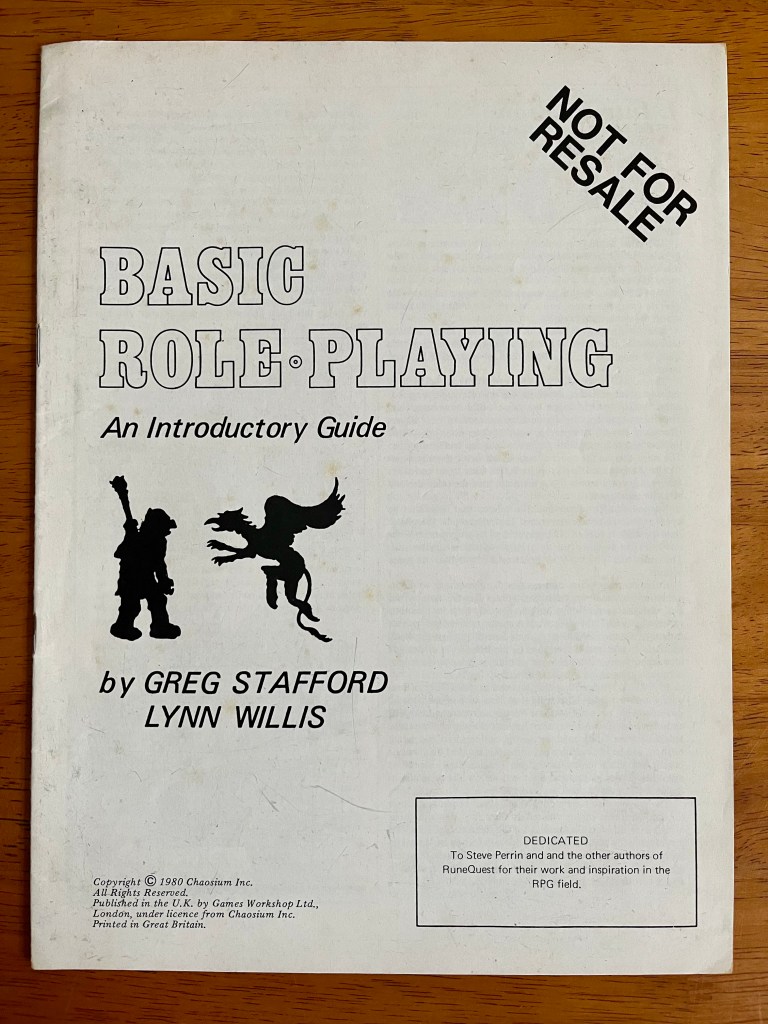
The Introduction spelled out to me for the first time – despite my having played in games of Traveller before encountering it – what “fantasy role-playing” is all about:
A fantasy role-playing (FRP) game is one wherein the players construct characters who live out their lives in a specially made game-world. The characters need not be anything like the people who play them.
Basic Role-Playing (1980), Chaosium, page 2
The accessibility of those initial pages and the examples given opened my eyes to a fresh and expanded vision of role-playing from an early age. I have spoken many times about how the main RuneQuest book itself, and the fantasy realm of Dragon Pass specifically, engaged my imagination and drew me deeper into these games.
But what of “ease of use”?
BRP introduced three ways to determine success or failure:
- automatic actions (no rolls required);
- “simple percentile throws” for most action resolution “under stress or requiring concentration”;
- resistance table rolls for “pitting some characteristic… against something else”.
This was resolved with the simple use of “two D20 of different colours” to create a D100 result. Through the long years, this game system has proven remarkably resilient.
Certainly the latest incarnations of Chaosium’s games retain this core mechanism of play, but the system has been hugely influential on other designers throughout the hobby’s history. For me, it remains the original core mechanism and holds a place in my heart for it’s simplicity.
Game on!
 Roleplay Rescue’s Blog
I think it has built a house in my heart~
LikeLiked by 1 person
Ummmm… You probably have a typo there… Because using 2d20 to stimulate d100 does not strike me as straightforward.
LikeLiked by 1 person
😁No typo, I can assure you. Back in 1980, there were no D10 dice. The rules state that you roll D20s because they were each numbered 0-9 twice, thus it was easy to generate a number from 1-100 by reading two rolled together. In those days, playing D&D was actually more fiddley because you couldn’t easily get a modern-style D20 numbered 1-20 and had to roll another dice to tell you whether to count the 0-9 roll on your D20 as high or low.
LikeLiked by 1 person
Ah. Makes sense.
And much more sense than “(20* (R(1)/5) + R(2))”…
LikeLiked by 1 person
[…] this week, reflecting on my past gaming and experience with BRP, I found myself once again paging through RuneQuest from 1980. I have famously failed to play this […]
LikeLike
[…] the Call of Cthulhu stuff has been drawing me closer. I have a long-standing love for the Basic Role-Playing System (BRP) through RuneQuest 2e and then there’s the idea of linking my love of modern […]
LikeLike