
What if we think about the characters in our games in terms other than the statistics on the character sheet and the abilities that we conceive of them being competent with? I’ve been thinking about creating character identity around the concept of overlapping circles of relationship.
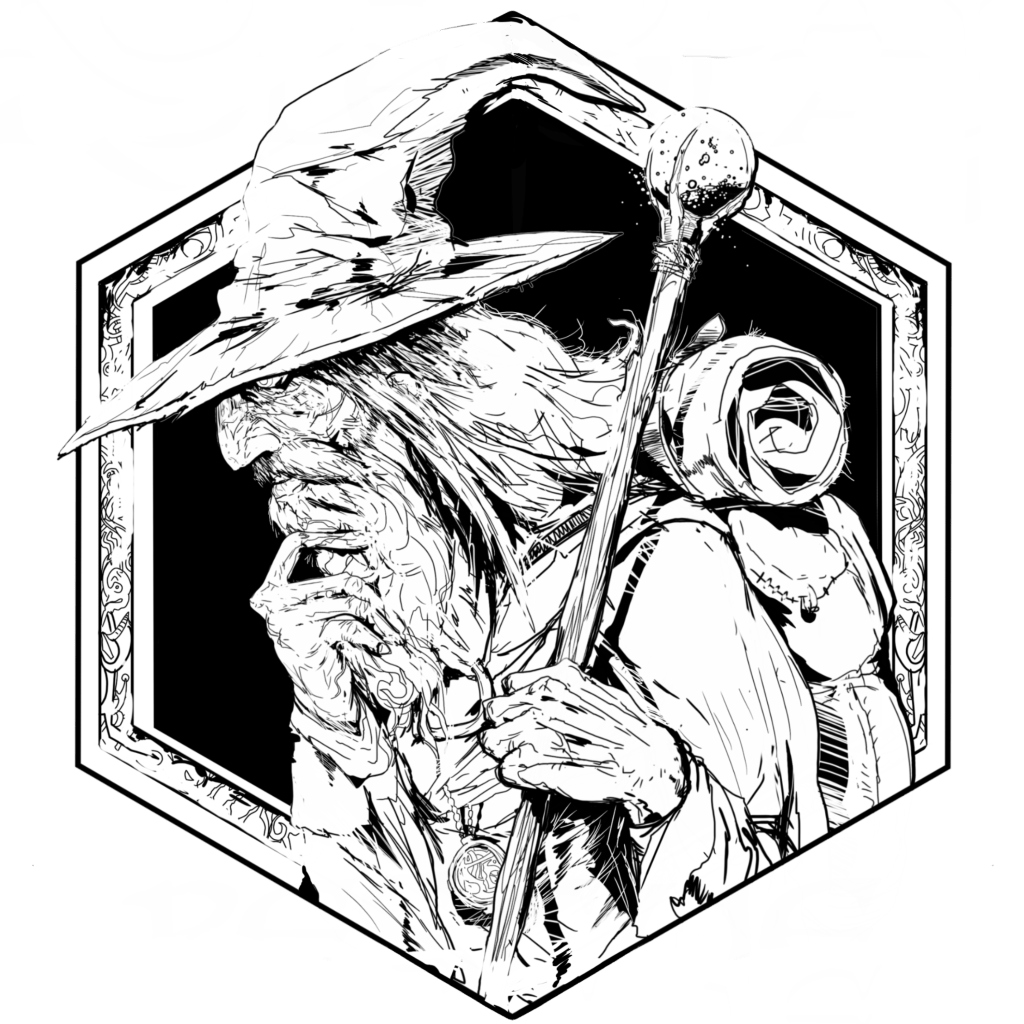
Let’s imagine the classical fantasy adventurer. At the beginning of the hobby, this character was conceived as being the product of six random rolls of 3d6 and the player’s choice of a class, an alignment, some hit points, and a roll of 3d6 for gold pieces. To this the player would add a name. This gives us something like:
Vel the Unworthy, Acolyte Cleric of Law: Str 8, Int 8, Wis 15, Con 10, Dex 14, Cha 16; 6hp; 90gp
This is character generation by random determination with a focus almost entirely on the mechanisms of the game. The player discovers who their character is and then proceeds swiftly into spending their gold before entering the dungeon. Arguably, the character is defined as much by their equipment than anything else.
Some of us are more engaged by the Fantasy of the imaginary world of the game than by the Challenge inherent in skilfully navigating those deadly dread dungeons with whatever assets random dice rolls give us. We have perhaps experienced the classic fantasy game in a manner akin to that of Sandy Eisen:
“I found the first few games intensely enjoyable and exciting; I really lived the part and my ‘willing suspension of disbelief’ found myself there – in the dungeon. My actions (and of course my thoughts about these actions) were dictated by real-life considerations and no thought of wargame mechanics entered my head to distract me from the ‘events’ going on.”
Europa 6-8, cited in “The Elusive Shift”, Peterson (2020), page 41
Of course, in those early days characters were not conceived of having a place within a wider fantastic world much beyond that needed to project them into the dungeon. As time passed, and as players began to look for a more “in-character” experience while playing the role of their adventurer, a shift took place which encouraged wider imagination.
Vel the Acolyte of Law was randomly determined for this post and his creation took less than a minute. As a player, I have questions: this Clerical order which serves the Principle of Law, what is that like? But I find myself also imagining an implied circle of relationships within an implied Temple of Law. It doesn’t take much to add layers.
Which village, town, or city is this Temple located within? If Vel is an inhabitant of the town of Jarviksholm, that name tells us something different than if he has grown up in the village of Gren. The former is rather more evocative of the world than the latter, suggesting a cultural tone from our own world’s history.
Does Vel have family? What if he is a husband, and brother, and a son? These decisions shape the character in our mind and suggest relationships. If we decide he is the “black sheep” of the family, having run off to the Temple instead of inheriting his parent’s farm, we have made him more interesting.
For a game in which poor Vel will simply enter the dungeon and likely be slain by a Giant Rat in the first room, this kind of effort is wasteful. Having played in many such games, I never used to bother doing anything more than rolling my statistics and choosing the optimal Class those numbers offered. Vel would likely die anyway.
But I have grown bored of such games. As much as I like the idea of Dungeons & Dragons played in the older vein, these kinds of games rarely offer me the player engagement that I am seeking: Discovery, Fantasy, Fellowship, Sense Pleasure, and Challenge. While wandering the mazey dungeons scratches the Discovery itch for a time, the Fantasy usually suffers.
I’m interested in who Vel will become not just in terms of his statistics – Level, hp, and spells – but also in terms of his place in the imaginary world. In fact, I derive a great deal of pleasure from the interactions that Vel will have during the playing of the game. The usual intersection of adventurer versus monster feels limiting.
What are the relationships in Vel’s Temple? Are there rival factions? Are Chaos Cultists openly operating or must he root them out of Jarviksholm through careful investigation? In recent years, I have found asking these kinds of questions up-front far more engaging than rolling six statistics and choosing a Class.
Which brings me back to the circles of relationship I posited at the beginning: what if we start character creation with such questions?
Where does Vel sit within the society that gave him life? What’s his social position? Son, brother, and husband were suggested. Perhaps a poorly-regarded son and brother. What does his wife think of him? What does she do while he is away on “Temple business”? Who are these siblings? Are both parents equally disappointed in him?
Relationship to family, friends, jobs, wealth, government, religious figures, organisations (like guilds and fraternities), enemies, rivals, allies, patrons… the list is potentially endless. My suspicion is that a few words in this regard would give the GM hugely greater creative latitude than simply listing your character’s six numbers, hit points, and Class.
Game on!
 Roleplay Rescue’s Blog
I like where you’re going with this line of thinking. It’s got me thinking of my own character in my son’s Eberron campaign. I’d love to have a not too long list of questions for me, or when the GM, my players to go through when create our next set of characters. Do you have any suggestions as to where to start? Any good resources?
LikeLiked by 1 person
There are many questions you could ask a player and, in actual play, I think you’d be best adopting Jamison’s interview approach with an adaptive conversation 1-1. That said, Jamison’s “Gamemastering” does include some suggested questions:
“How did you end up in your profession?”
“Who are your (or your profession’s) enemies?”
“What do you think is worth fighting for?”
“Who are your friends?”
“Where were you born? Which class do you belong to?”
“What goals do people in this profession have?”
Those could naturally lead to deeper development, such as naming and describing the people mentioned or asking why they like / dislike the character.
LikeLike