
The big draw to roleplaying games for me has always been the Otherworlds – those fantastic realms and universes – with which we roleplayers populate with characters and explore. Alongside this appeal has always sat the desire for a believable creation which I inherited from my wargaming roots.

Most people play for different reasons: maybe it’s the emergent story, sometimes it’s the opportunity to fight and win battles, other folk enjoy acting the role of their character, and much more. I was drawn first to the man-to-man level of combat and tactics, then to the exploration of diverse places, and finally to the rich experience of the fantastic world.
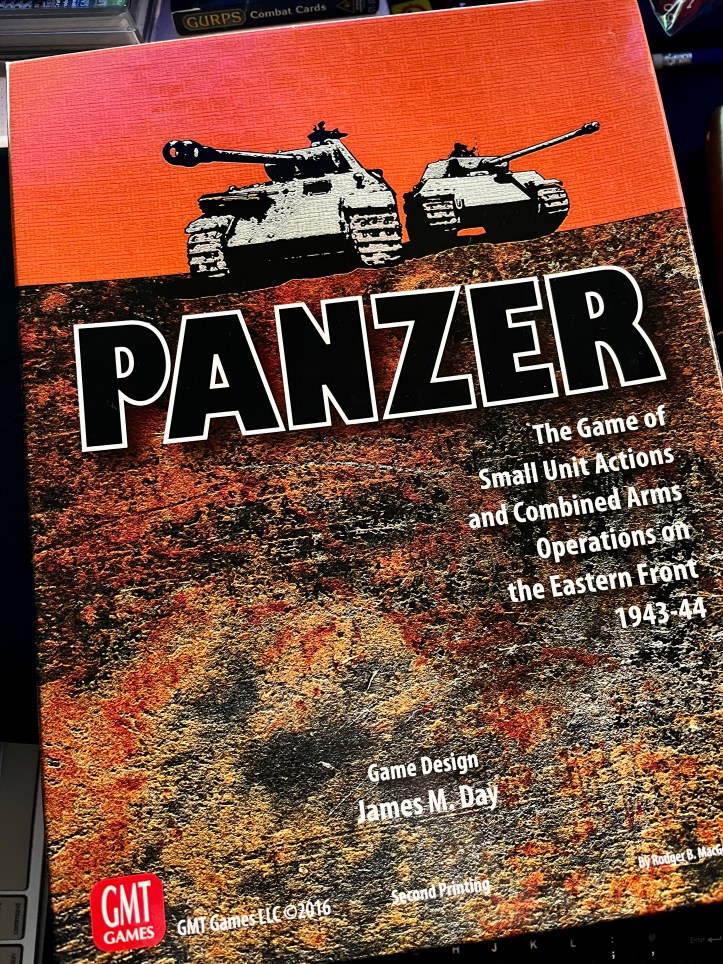
A strong element to my play has long been the desire to emulate the situation faithfully. As a wargamer, I was raised to create scenarios that were fictional and yet believable. For example, in Panzer (a WWII combined-arms wargame) we paid attention to the historical production dates of vehicles and loosely based our battles on the campaigns of that conflict.
The rules were designed not just to be playable and fun but also believably realistic – this was called simulation gaming, seeking to recreate the experience of battle through the mechanisms and methods of play. Panzer was a favourite of mine because it combined three elements I love: tactile hex-and-chit board gaming with dice, detailed and yet playable rules, and a dedication to historicity.
When I began to roleplay, I enjoyed the experience of making decisions in character and the “fog of war” (itself inherited from wargames) around situations – the experience of only knowing what your character can believably know. I delved deep into the exploration of fantastic worlds and the battles against monsters and other evil creatures. But as I began to read the rules, I found them distinctly lacking in detail.
Anachronism bothered me with D&D, as did the abstract nature of combat. The looseness of the rules and the dependence on the GM’s Fiat were fine when playing with trusted friends but quickly became a problem when attending shows and meeting strangers. As was the fashion in the early to mid 1980s, games began to be released with more attention to detail and I was drawn towards them.
Yet I never learned to GM the group as a teen. I was a player in roleplaying campaigns and a solo gamer when I shut myself in my bedroom. To be honest, I probably played more wargames solo than I did with people throughout my teen years. Similarly, I developed my tastes for roleplaying in rich, deep, Otherworldly places while alone in my room.
These days I truly miss playing simulation games of all types. It seems to me that the world of gaming – across the whole swathe of board-, war-, computer, and roleplaying games – is dominated by a desire for easy play and abstraction combined with simplistic plots and deeply stereotyped characterisation. It’s entertainment that sells and there is nothing wrong with it.
I just don’t enjoy easy, abstracted, simplistic, and plotted play. I like challenge and exploration. There is no challenge in mastering the rules, the scenario, the battlefield, or the world if it’s easy. There’s no joy in exploring shallow worlds and stereotypical relationships. It’s fun for a little while but, in the long run, I’ve been there and done that.
But here’s the tension: on the one hand, I enjoy bringing new players into the hobby of roleplaying and wargaming; on the other hand, I am seeking depth and challenge. New players have to start somewhere and the safest introduction is simple, abstracted, and typical trope dungeons. I always want to go deeper.
The question is how to add depth and challenge to an Otherworld that can also accommodate the new player? The route I am taking is the route I myself walked: to begin simple and abstract, to offer more depth and detail to those who want it, and to keep myself interested by plumbing the deepest delves alone.
In a world that seeks to dumb down and sell to the lowest common denominator, to appeal to the broadest market, and to keep GMs on the treadmill of buying and trying new things, I am stepping aside. There is a narrower path that leads into dark shadowy realms where we care about the details. But quite honestly, I don’t think many people care about that path.
I never wanted to play in a World War II tank battle where Tigers rolled over the fields of early 1940 France. I disliked the power hungry 40K Tournament games where players thought it was fun for their opponent to be obliterated in the first turn. I was bored by the D&D games where every character felt the same because of optimised builds designed to win battles.
I just as strongly disliked the long march through pre-plotted campaigns where, in wargaming, you weren’t allowed to win a battle if it was lost in actual history. I was just as annoyed by the pre-plotted Dragonlance-style adventure path where I could more quickly find out the resolution by reading the book (or GM’s notes). I’ve been railroaded and limited for far too long.
Give me the freedom of my imagination, the detail and complexity of a game worth learning, and a world worthy of exploration. Give me secrets to discover, relationships to interact with, and places to delve. Let me choose my character and my goals. But if you sit at my table, understand that I don’t care about your optimised build and game balance, nor will I save your “hero” from ignominious death if they behave like an idiot.
I want to believe in your character, the fantastic Otherworld, and the games we play together. I want to escape the real world for a while into one that is probably far more dangerous but also far more rich with adventure. Tigers didn’t fight before 1942, armour soaks up injury, and – no matter how “cool” you try to be – physics will always win.
Game on!


When I was younger the abstraction of AD&D combat bothered me. I wanted to know exactly what my character could do, exactly when he was doing things, and exact measurements. I was therefore very drawn to Champions. These days I find myself more comfortable with an appropriate level of abstraction. What is appropriate? I know it when I see it! I’m find with D&D and all versions of Traveller.
LikeLiked by 1 person
Right on. I’m a big fan of simulating a world, with concrete game mechanics that have a direct correlation to the reality of that world.
Not much to add, other than I’m also not a big fan of games that shape the choices of players/characters, or the outcomes of their choices to mirror other narrative or dramatic forms. I like the ‘trappings’ of a genre, but not necessarily the ‘tropes’. I want to simulate the physical, psychological and social reality of a setting, not emulate the typical narrative arcs and structures of the books, movies, etc. usually set in that setting.
LikeLiked by 1 person
Yeah, me too. I am not wanting to simulate cinematic action or the narrative forms of other mediums. I like what RPGs offer as a distinct medium for emergent narrative and I seek that in a grounded, believable, realistic world.
LikeLike