
One area of reflection has been the idea that I enjoy several variations of game play that are often lumped together into the category of “roleplaying games”. While many folk tend to assume that the term “roleplaying game” (RPG) is a firm one, the reality is nuanced. Being able to “attempt any action” is perhaps the most central facet of RPG games but there are other elements to consider.
Many published RPGs have within them a set of play goals that essentially underpin the experience generated by that game system. Each play goal is essentially a choice being offered by the game designer to the players. RPGs generally require someone to “run” the game – the Game Master (GM) – who is offered some different challenge to that of the player characters. If nothing else, the GM gets a vicarious pleasure from running a game for their friends and setting up the challenges.
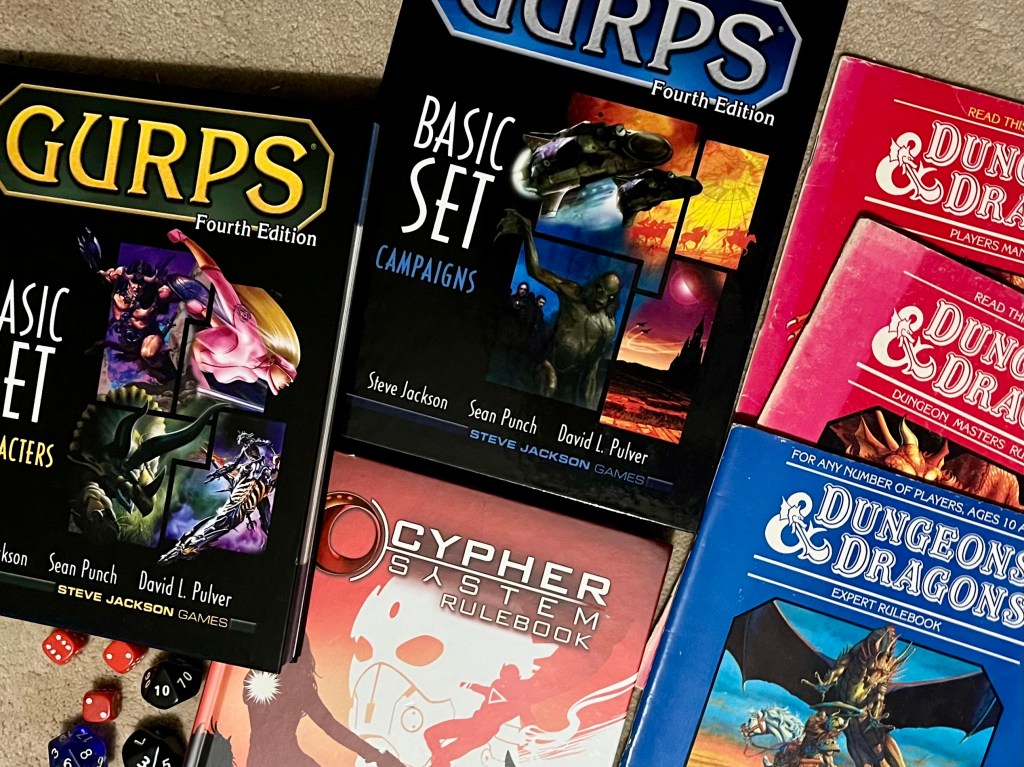
Take for example the classic Dungeons & Dragons game which offers the opportunity to take on the role of a dungeon adventurer delving for treasure. In this game, player characters advance based on the accumulation of treasure recovered from the dungeon and monsters defeated. Treasure recovered gains experience points which, in turn, allows the player character to improve in power. The majority of experience points gained will likely come from accumulated treasure. The game is therefore focused on the goal of finding treasure. Players can clearly track their progress within the game as their exploits allow the character to “level up” in experience.
Compare this to the offer of playing an heroic character taking part in an exciting story which emerges through play. The Cypher System makes this offer, streamlining game mechanisms to reward players who accept complicating “intrusions” from the GM – you gain XP when the GM proposes some event that impedes progress and makes things more narratively interesting. You also gain XP from making “discoveries” related to the game world, such as uncovering some truth that is significant to the tale. The game is therefore about exploring the situations that emerge and dealing with complicating events. Mechanisms that allow your character to embark on interesting “character arcs” – typical story tropes which require steps towards a particular narrative outcome – add optional means to gain XP.
The offer of roleplaying a character within an Otherworld solely for the purpose of experiencing the pleasure we derive from roleplay itself is a different play goal. When we strip away the meta-goal of earning XP to level-up or generating an exciting story, we leave it to the player group to establish what the game is going to be about. This becomes a different kind of challenge for both the player and the GM because it’s incumbent on the group to establish the reason for play.
In my Karameikos campaign, for example, we established that the Otherworld would be an interpretation of the published Mystara realm of Karameikos, originally designed for play with the D&D Basic/Expert Sets. But this was not a game powered by those game rules and therefore it does not have the “go get treasure” goal established by 1983 BECMI D&D. In fact, the use of the GURPS game system means that we had to decide what the game would be about.
What we discovered is that the Karameikos campaign is about the activities of the six player characters (PCs) created by the players. Each PC has their own personal goals within the imagined Otherworld. Those goals provide the impetus for play and drive the action of the game. For example, Ser Lukas wants to avenge his troop of Foresters who were ambushed and killed by agents of the Masked Man. Valens, by contrast, is seeking to discover more about the ancient Dwarven culture of his ancestors.
In such a game, the Otherworld itself needs to be a key focus of play. As GM, I am challenged to provide a believable and consistent sense of “reality” within which meaningful choices can be made by player characters. The excitement and interest arises from the challenge for the player to make those choices as-if they were their character. This is make-believe writ large and the primary experience is to inhabit the role of the character played. As GM, I get to roleplay those other characters who intersect with the PC’s activities.
What do we reward in such a roleplaying game? Because we use GURPS, players can earn the meta-reward of “character points” (CP) with which to improve their PC in any manner that seems appropriate and interesting. We reward showing up to play and giving your time to the venture as a collaborative play experience with 1 CP. We also reward significant achievement of personal goals – whether individually as the PC or collectively as part of the party – with bonus CP. Finally, we award a bonus CP to the player nominated as having provided the most significant moment of roleplay in the session.
Personally, I enjoy all three of these types of roleplaying game experience to some degree. The most rich and rewarding in my experience is the latter – Karameikos being the game that I am running in this style at present. That said, I have found an interesting blend by using the Cypher System to run Ariadne’s Thread with a different group of players in a science-fiction Otherverse. While we are very much focused on roleplaying in-character as-character, the system’s focus on emergent story lends a slightly different experience. An interesting story is arising.
There is a great deal of nuance here. I am not sure if I can adequately convey these shades of experience.
As I write this, I am revisiting the D&D flavour of roleplaying game with some curiosity. I recognise that I very much enjoy the meta-goal of exploring a dangerous Otherworld populated by places of mystery and treasure. It’s a different shade of play experience which taps into the part of me that enjoys the tangible goal of accumulating gold coins and seeing a character level-up. It is seemingly much less conducive to the in-character as-character play experience I usually push for but… I suspect that with the right group of players, I could make an enjoyable offer of play.
My point is that different interesting play experiences are on offer within the wider “roleplaying games” category. Some of those offers really do not interest me personally: games that take the “generate a cool genre-specific narrative” meta-goal much further, like Mothership does for SF horror. Many proposed Otherworlds don’t interest me either – playing in Fallout or Dune. This is the realm of taste and preference from which other people are going to enjoy different flavours. That is healthy difference.
Taking my point further, I recognise three broad variations as being something I seek to explore right now. Karameikos stands as my flagship RPG experience at present because it offers the richest and most refined roleplay in-character as-character. If you want to explore why that’s great and how to achieve it using the GURPS game system, listen to GURPStalk. Links to various podcast platforms are on that blog page.
I am enjoying the experience of slightly more focus on emergent story in Ariadne’s Thread played with Cypher for different reasons. I have a group of players who like the more action-orientated and cinematic tone that this RPG system provides. It’s less grounded and realistic than if I were to run the same Otherverse using GURPS. Whilst it’s early days in this particular game experiment, early sessions have been intense and enjoyable for all.
I also want to explore the experience that the older D&D game provides and experiment with bringing a more firm in-character as-character lens to that system. I have found a more rarefied variation of that original game engine, one designed specifically for long-form play, which I am tentatively reading through and absorbing. As with all play experiments, it might not pan out or I might discover I am not so interested after all… yet I sense something intriguing.
Overall, I am realising that I am not a purist when it comes to roleplaying games. I have some pretty specific preferences in play, certainly, but I am less fussy than it might sometimes appear. My primary goal is to enjoy the roleplay of a character, whether as a player (less common) or as the GM (my preference), and offer my friends the in-character as-character approach. I see this as a key distinction from a board or wargame for roleplaying games.
That said, I am curious to blend the specific offers of game play goals with that larger meta-goal of roleplay. I think it’s most rewarding to give players the opportunity to create any character that fits the chosen Otherworld and determine the overall personal and team goals for their characters. This is player agency at its highest setting. But not all players are ready for that. Some players simply don’t want to take on that challenge at this time. Newer players, in particular, are perhaps not there yet.
I wonder how exploring some old territory with a new lantern will work out. Will I find some treasure?
Game on!
 Roleplay Rescue’s Blog
Interesting musings! I find myself unashamedly enjoying lots of different sorts of rpg – I was even recently inducted into the hitherto unknown joys of skirmish games via Bloodbowl. My favourite game is Ars Magica, which strongly rewards long-term, player-character-goal-driven play with lots of interaction with the mundane and supernatural aspects of the Otherworld. But I’ve had a blast running Old School Essentials with family, or managing a small band of doomed peasants in DCC, or even (heaven forfend!) constructing a *plot* for a game of Star Trek Adventures.
Why do we feel the need to be partisans of just one Sort Of Thing? Perhaps it comes from being defensive against the D&D-5e-Only crowd, and we feel we must provide a justification for any other game as worthy of survival. This can lead to putting a style of play on a pedestal: This matters! This deserves to BE!
But games are play, and play is for its own sake, and not to be justified by appeals to anything outside itself. We (and I do include myself here) all probably need to relax, try things out, and don’t stress if we don’t like something, without painting ourselves into boxes as a result. I might even let myself enjoy some 5e…
LikeLike