
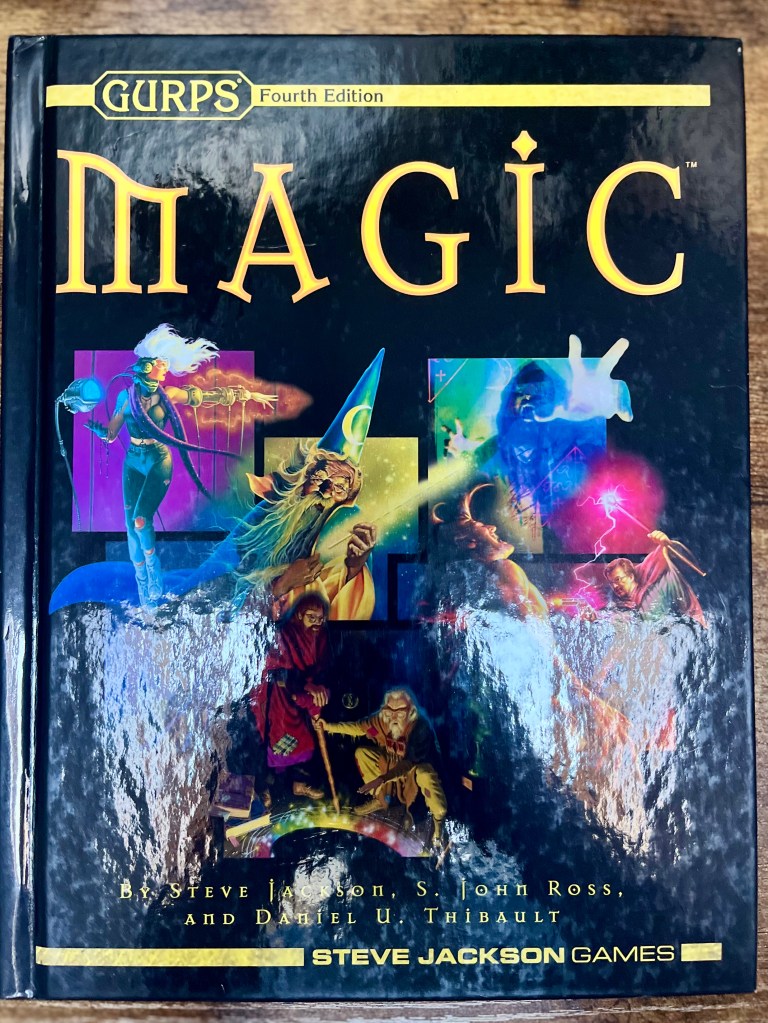
Confession: I like the GURPS Magic system as presented in both introductory chapter in Basic Set and the full treatment in GURPS Magic. Over the past four years, I’ve run several fantasy genre games and never needed anything more. Here’s three reasons why.
1. Pick Up and Play
GURPS is a pretty easy game system to grok. As long as you know what you are trying to run, the system can be utilised to provide your needs. With just the Basic Set, you’ve got 93 spells from sixteen colleges – about 5 or 6 spells for each “flavour” of magic – which is more than enough to get your new characters started.
Spells are bought just like Skills in GURPS. They work the same way, in that you buy them with character points and roll to test them when it comes time to put the spells to use. The main difference is that Spells cost Mana (read: Fatigue Points) to cast. Yes, there are different categories of Spell – like Regular, Area, Information et al – but it’s easy to use.
Spell casters choose spells in a sequence from simple and basic through to more complex and powerful spells. What’s great about this is the fact that the player can learn the basics of spell-casting alongside the growth of the character. Learning to use the many low-powered spells encourages clever play, teaches the player how to make use of the system, and rewards development over time.
2. Encourages Roleplay
Which brings us to the fact that GURPS Magic (like the rest of the system) encourages the player to roleplay their mage. Because the system has associated mechanisms – whereby what the character does with the spells is married to the way the system works – it feels like you’re spell-casting in play. It’s therefore easy to think like a person who knows magic.
Example: You want to cast a Fireball spell. The first step is to summon the fiery ball to my hand. The spell-caster says the words and makes the hand gestures while the player tests their Spell skill on 3D6. The caster decides how powerful they want the fireball to be and spends the Mana energy (Fatigue Points) to power it. For each turn up to three, you get to add to the size and power of the Fireball. Then you throw it – check your Innate Attack skill to hit!
What this close relationship between the decisions of the player, the action of the character, and the mechanisms of play does is make you feel like it matters what you do and how you do it. Non-abstracted magic, grounded in the same basic engine of the game, but encouraging you to describe how you are using it. This is subtle and non-obvious to the person who hasn’t tried it… but in play, it’s powerful and cool.
3. Lots of Options
GURPS Magic contains 1001 spells from 24 spell colleges. There’s a whole system for magic items and having characters create them (if you want it). There’s a whole alchemy section for potions and elixirs. There are options for using the core magic system in different ways: priestly magic, shamanic magic, ritual magic, wild improvisional magic, and more.
Basically, you can probably do something like the kind of magic that your favourite fantasy genre source material needs. It’s loads more flexible than you realise and, as with reason one above, it’s easy to make a simple optional change: easy to play around with. Sure, you can also use GURPS to do magic via Powers or one of the systems presented in Thaumatology, but for someone learning GURPS, well, Magic is a great start.
From Experience…
Actual play over the past eighteen months in long-form gaming with my main group has shown the benefits of GURPS Magic.
Firstly, you get a bunch of spells to begin with – a dozen low-powered but useful spells is enough for a newbie player. Not limited to the one spell of a Level 1 Magic-user (like the old days) but neither overwhelmed by the extra rules 5e makes the player learn. Just roll 3d6 to cast, spend the Mana, the spell goes off.
Secondly, the spells encourage creative usage. Players can enjoy finding ways to utilise the small powers the spells give in clever ways. The player of the mage gets to feel versatile and smart while the party gets to break a few laws of nature in support of their mission. There are no limits to the ways in which a dozen spells can be leveraged.
Thirdly, it’s easy to adjudicate the spells because they are very simple to use. The types of spell fall into a small subset which is easy to learn and remember at the table. The spells themselves are limited in scope individually, so you don’t have that annoying need to look them up after the first time. In fact, the text is short enough to gather into a reference sheet.
Overall, the GURPS Magic system is the easiest spell system I’ve run. But it is also versatile and varied. That makes it interesting and useable. Sure, if you want to build a more expert mage then you’ll need to have more system mastery but the best way in – i.e. learning by running a lower-powered apprentice over a long period of play – rewards the player with that knowledge.
And that’s the main thing: GURPS rewards long-form play. So does the magic system.
Game on!
 Roleplay Rescue’s Blog