
On September 16th 2018, I wrote a post entitled, “The Why of Fantasy Roleplaying Games“. When I imported it here, on July 27th 2020, I lightly edited it. Five years later, and after many events that have reshaped me as a person, this post revisits that older one and updates it.
All my life I’ve been a loner, much more comfortable in my bedroom with the door closed and music blocking out the world beyond. Back when I was four, my best friend was my dog, Heiko; the strongest connection I felt to my family came through playing games together, even if that usually meant defeat and frustration for me.
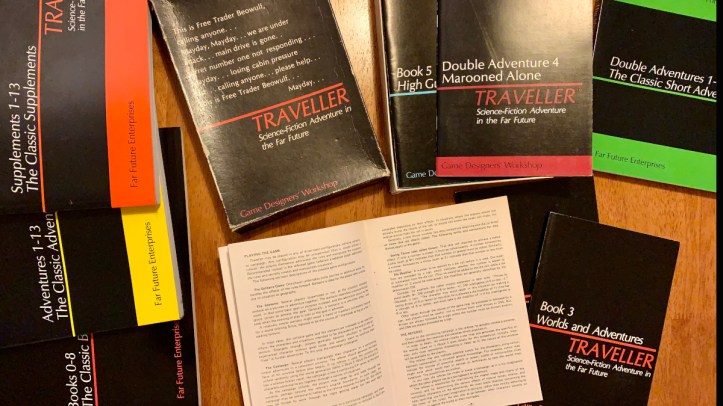
I started playing wargames with my Dad aged around 6 years old. This was 1977 and stood alongside my exposure to cinema with Star Wars (Episode IV as it is now known). Sometime between then and 1980, my friends began to play board games and eventually we discovered Traveller. This was my first roleplaying game experience (not that I realised it).
Discovering Roleplaying
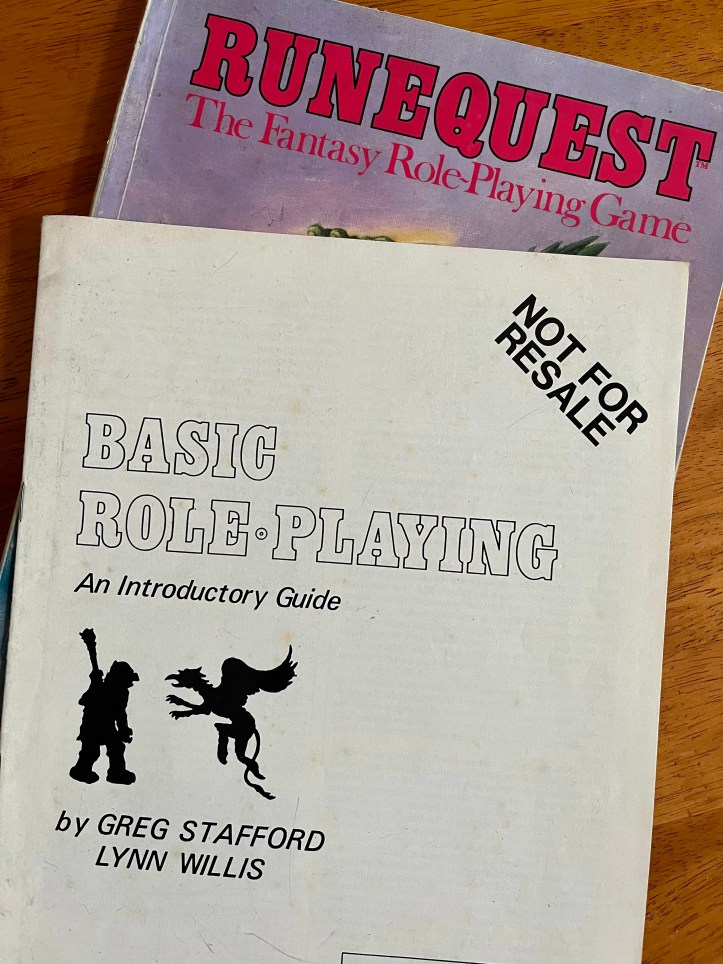
Dad bought RuneQuest in 1980. I remember him commenting on how he’d been reading about these “roleplaying games” in the wargaming periodicals that he collected. I vividly remember his visceral rejection of that game and the ease with which I was allowed to squirrel the box away to my room.
I devoured the ideas in RuneQuest and discovered a world that resonated with me like no other. It wasn’t about victory in an absolute sense but rather about adventure. There was a whole world to explore and you could be the hero from an exciting legendary world. Most formative of all was the little white booklet entitled, “Basic Role-Playing“.
At 11 years old, about a year after discovering RuneQuest, we went to High School. My friends had begun to play games like Dungeons & Dragons and Star Frontiers. My best friend was Daniel and his house was the regular refuge for play, both before and after school most days.
Over the seven years I attended that school, the roleplaying hobby was the thing that kept me sane and helped me find acceptance as a human being. The community of gamers helped me discover who I was, and that it was possible to be me without being judged. The roleplaying allowed me to explore imaginary worlds and paradoxically find out who I was.
Discovering Acceptance
Games, and roleplaying games in particular, have been my biggest “way in” with other people. The communities of gamers that I have been involved with over the years have been places where everyone was accepted for who they were as we shared play filled with creative discovery.
This is why I have repeatedly created communities of gamers – so that everyone could feel accepted and, most of all, so that I could retain a sense of belonging. I believe it’s paramount that people learn to accept other people, just as they are. My primary way to achieve this has been to create communities of discovery built around roleplaying games.
Ever since I was a Games Workshop store manager, I’ve used games to draw together disparate teens and give them a sense of belonging. Since becoming a secondary school teacher, this trend has continued through the organisation of an RPG Club into which we invite students to come and discover the power of their imagination.
Deepening Roleplay
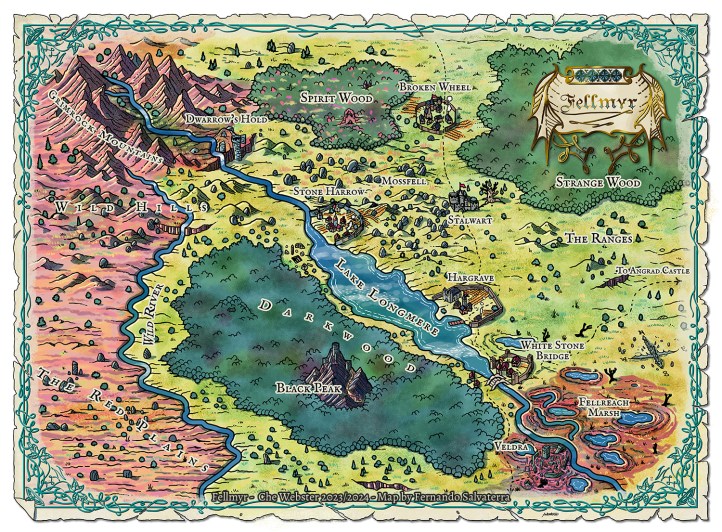
Over the past seven years of podcasting and blogging here, I’ve re-discovered the magic that I first experienced back in 1980: that invitation into the fantastic otherworld of Glorantha was the gateway into realms of imagination and enjoyment that, somehow, I managed to lose sight of over the years.
The experience of imagining oneself as a person in another world is the primary motivation for my continued exploration of the “Basic Role-Playing” idea. That game was formative. I’ve come to recognise that, of all the possible ways of using roleplaying games, for me the most enjoyable is to take on a role and play as-if I am that person in their own otherworld.
Finding like-minded players and GMs who share this desire has been a return to that sense of belonging that I experienced at the beginning. Although for years I felt outcast, not quite fitting it to the other playstyles that have become so fashionable, it has become clear that I am not alone: there are others who want to enter the otherworld as an imaginary person.
Worlds and Characters
The reason I role-play is to visit imaginary worlds and explore specific experiences within them. This is achieved by inhabiting the role of a character – a person who lives in that otherworld – and playing as-if I were that person. Whatever goal the character might have, whatever challenges they need to overcome, the magic is in the sense of being that person.
This is an experience of play that draws upon the deepest yearnings of the child within to make-believe. But RPGs are also very definitely games which aim to generate a sense of verisimilitude through the application of consistent and reasonable rules. It’s the blend of “anything is possible” imagination that is paradoxically grounded in rules which entices play.
Recovering this play at the table, face-to-face with other likeminded people, has helped me to rediscover that I belong. Just as in the days of school back in the 1980s, the past year especially has reminded me that gathering to roleplay is also to gather new acquaintances and give life to not only imaginary worlds and heroes but also to the possibility of friendship.

I’m still very much a loner, much more comfortable in my hobby room with the door closed and music blocking out the world beyond. But through the magic of these role-playing games, I’ve learned to take on new roles in real life too: the teacher emerged from learning to run a game and share my excitement for imaginary adventure.
The why of roleplaying games is bound up in questions of who we want to be, the spaces we want to create – both physical and imaginary – and the value of sharing this with other people. These are more than “silly games”. Roleplay is about becoming and discovering yourself.
Game on!
 Roleplay Rescue’s Blog