
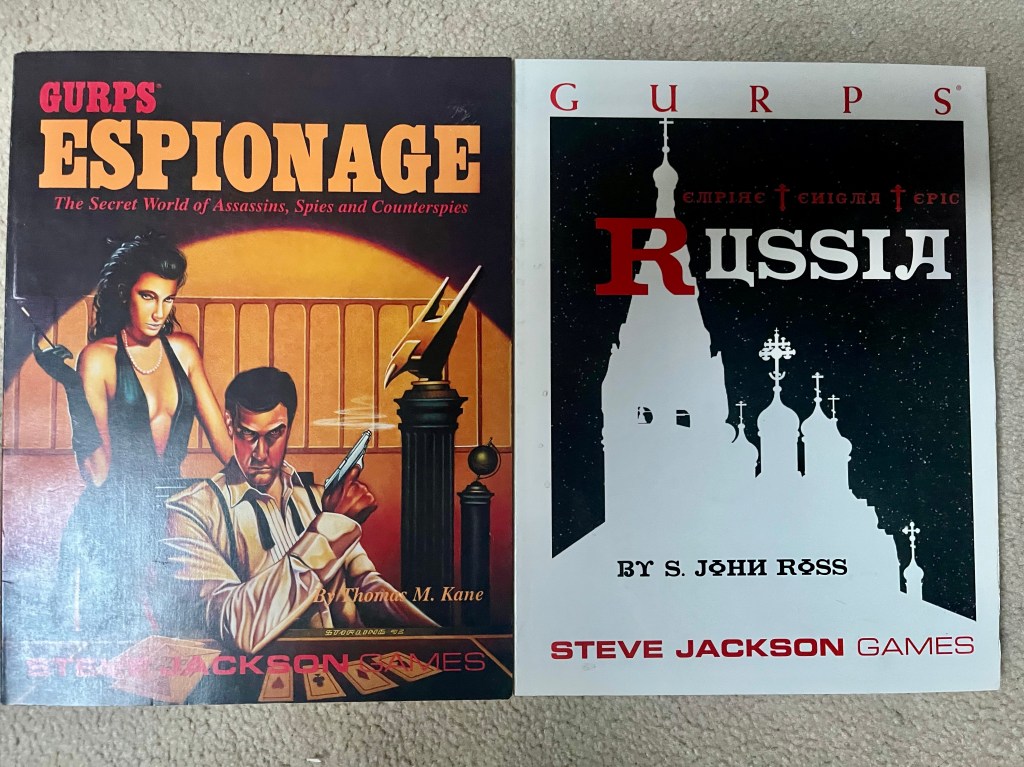
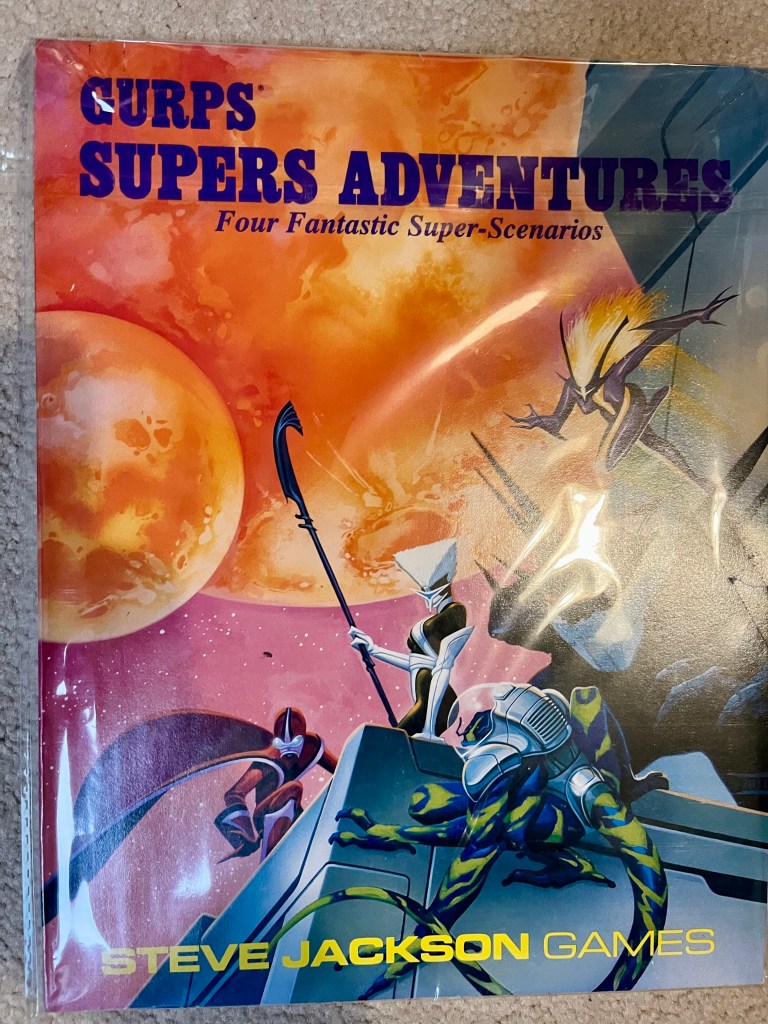
In conversation with fellow Nottingham Dice Cup player James last weekend, we once again touched on the difference between roleplaying games as a hobby and the somewhat distinct sub-hobby of collecting RPGs. I’ve been mulling on this as, throughout the past couple of weeks, I added to my GURPS supplement collection.
For many years, I thought my RPG hobby was being maintained simply because I was buying and collecting RPG rulebooks, settings, and supplements. Looking back on it, I realise that as laudable as it might be to support the game designers, world inventors, and supplement authors in their industry, it’s not quite the same thing as playing RPGs.

That might seem obvious to some and controversial to others. To me, there is an obvious overlap between the activities but the distinction lies in the question of whether my buying another book (whether paper or .PDF) is in fact the same as playing a roleplaying game. To me, collecting and reading is not the same as playing.
Thus I have a collecting hobby which supports and enables my RPG gaming hobby. Sometimes, however, the collecting hobby gets in the way of the playing part. There have been times when collecting (and reading) the books for a game system has supplanted the act of play. I get inhibited by all the reading I perceive I need to do.
Historically, this might be a large factor in the appeal of so-called “rules lite” game engines. If you’re overwhelmed with the complexity of collecting, reading, and supposedly knowing all the words in a game then perhaps having only 2-4 pages to read and digest is appealing. Except I notice that many rules lite games accumulate vast troves of short but collectable additions.
How many of these game books have I actually played with? Doesn’t the new shiny book just add to the growing and groaning shelves and make it less likely that anything else will get used? Why am I collecting these books anyway? As James and I reflected, there is an industry whose survival depends on us buying the latest tome they churn out.
What if none of it is actually necessary to roleplay? I mean, once you have the basic idea of a roleplaying game – the combination of a fantastic world, some pragmatic rules, and your methodology of play – do you really need anything else? The main benefactors of my collecting habit are the businesses who produce more product.
I say this as a published author of RPG supplementary material, as a podcaster, and as a blogger. It’s not my job or my main living but, yeah, I’ve contributed. I also don’t mean to say that it’s all unnecessary and therefore we should stop buying and collecting it. I’ve added to my collection just this week with a clear conscience.
There’s a joy to collecting and to reading. I love to learn and expand my bank of ideas. I enjoy the variety that different authors’ works offer me. But it’s not the same thing as sitting down at the table and playing with some friends. The RPG hobby lies in the act of play itself, not the collection of books.
I’m aiming to focus more on the playing and less on the collecting, especially of new sets of rules that I know (in my heart) I’ll not likely play or need. What I could do with more of is sitting down with friends and sharing the joys of roleplaying as an experience. Failing that, I could get more from playing solo than I can from another purchase.
Game on!
 Roleplay Rescue’s Blog
“There’s a joy to collecting and to reading. I love to learn and expand my bank of ideas. I enjoy the variety that different authors’ works offer me. But it’s not the same thing as sitting down at the table and playing with some friends. The RPG hobby lies in the act of play itself, not the collection of books.”
That pretty well sums it all up. I view my collecting as the same as keeping up on blogs, forums, and social media. In the old days, it would’ve been my monthly Dragon magazine. It’s all in support of actually playing; staying informed, dragnetting new ideas into my games. I’m a relentless omnivore when it comes to gaming. I learn to play Rules As Written, then begin adding ideas from a wide variety of sources.
LikeLiked by 3 people
Collecting and reading games and supplements even when you know you’ll probably never play them can be beneficial to your RPG hobby. You never know where you’ll get an idea you like for a setting, a mechanic you can add to your game, or a methodology you want to try. Absorbing what other people are doing in the hobby almost always has the potential to expand your point of view as to what you can do in your hobby.
LikeLiked by 3 people
I do feel a little bad about the number of GURPS PDFs I have that I haven’t gotten around to reading thoroughly, though. They always promise something valuable for my games, but I don’t make the time to get all the way through them.
LikeLiked by 1 person
“I get inhibited by all the reading I perceive I need to do.”
Oof. I know that feeling all too well. I also find myself locked into a decision paralysis when I have an idea of what I want to play, but have multiple books/systems in my collection that could feasibly run it.
LikeLiked by 1 person
<looks over at bookshelves full of RPG material I mean to read>
Entirely understand the collecting part! and the decision paralysis: too many choices is worse than not enough choices I feel.
LikeLiked by 1 person
While it’s about miniature wargames rather than RPGs, this is quite an interesting article on the topic of not buying more things and taking the time to appreciate what we’ve got: https://bedroombattlefields.com/the-slow-hobbyist-a-manifesto/
As you say, there’s nothing wrong with getting more books if you’re enjoying them, but there’s a lot to be said for picking something that works for you and really mastering it! These things are not mutually exclusive even, but they do tend to end up in opposition when you have to make the most of your meagre grownup allocation of free time.
LikeLiked by 2 people