
Continued from New Frontiers, Part I
GURPS offers a very high level of customisation and choice for your campaign world. The rules are servant of the setting so you need to make some decisions before you can really bring those rules to bear on supporting the world. Alongside the World and the Rules there sits the Methodology of play. This latter element is often invisible to gamers because they simply assume that it’s the same as using the Rules.
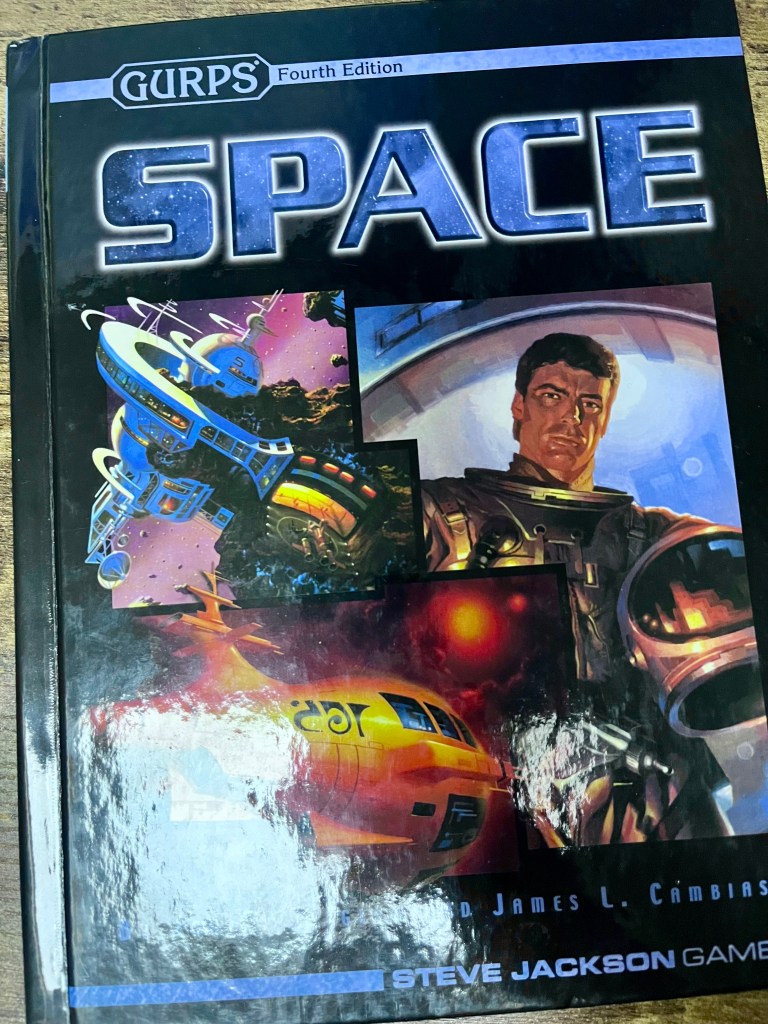
For any campaign that I run in this science-fiction universe things are going to operate based on some clear Methodological decisions. Firstly, this is a ‘sandbox’ universe in which players can potentially create a wide variety of interesting characters and form different types of group. Grabbing GURPS Space off the shelf – it’s a genre book and holds loads of great information about the broader Space adventure genre – I determine to make space in the initial play area for different types of campaign.
Strange New Worlds: Because Discovery is the strongest personal engagement that I hold in gaming, I want to make sure there’s plenty of opportunity for exploring new worlds and locations. Players can be offered one of two approaches here, being either members of a government Scout Service sent out to make contact with new worlds, or crew on a private exploration mission seeking to locate valuable resources. There’s scope here for scientists, rangers, diplomats, merchant reps, and all the spaceship roles for a vessel out on the frontier.
The High Frontier: The offer of exploration also strongly links to the concept of the frontier where civilization meets the unexplored wilderness. The offer of the High Frontier is adventure on one particular world that sits on the edge of civilised space. This is where freedom and opportunity meet danger. Colonists on a new world have the challenges of setting up settlements and exploring the world in detail. There’s room here for many types of character, including all those mentioned above but also adding in planetary marshals and administrative leaders. The main difference is it’s less space-born and more planet-bound.
Military Campaigns: I like Military SF so I want the offer of playing a heavily-armed squad of soldiers or space marines to be on the table. The setting needs to have some conflict baked in that will require the heavy hand of military force, be it ground-pounders or space jocks or even command of the bigger spacecraft. There’s the possibility of blending military elements into other types of campaign, such as the military exploration craft or the colony world that has a contingent of soldiers on base. But I’d also like there to be opportunity to board derelict spacecraft and shoot alien creatures.
Stop In The Name of the Law: Space patrol versus space criminals is a mainstay SF campaign idea. Players could choose characters from either side of that divide, playing doughty lawmen seeking keep peace and order or the low-life perps who are trying to make a living at the expense of others. This requires areas of civilisation to exploit, although there’s a difference between city-dwelling high-tech rogues and those smuggling to the frontier. I’d like worlds with space for both types in the setting.
Media and Politics: The only element from this area of play that interests me is the espionage campaign featuring intrigue, covert operations, and double-dealing among the stars. I can see room for military intelligence agencies, undercover cops, and interstellar spies from deeper in civilized space. It might be fun to have agents from the larger society infiltrating newly-discovered worlds to evaluate them for exploitation or first contact. I’m happy to run an espionage game but it needs to be dialed in carefully.
Working Stiffs: Merchants and prospectors is not my favourite angle but given the above parameters, it’s certainly something that can easily slip into the frame. Certainly the crew of a merchant ship plying the space lanes in search of profit is a well-worn path to adventure. Prospecting is probably best subsumed within the exploration plans of missions to strange new worlds, but if they really want to play miners on an asteriod, well, I am sure that can be arranged. Perhaps it’s just me but this feels a little too dull for my tastes.
The Absurdist Campaign: No, thank you.
Taking all this together, I need a sector of space mapped to include a range of interesting worlds to explore. There needs to be at least one well-settled world and perhaps one or two nearby new colony worlds. From there, there need be a range of different places to explore filled with varied challenges. In my mind, I am picturing an area that was once part of a larger civilisation but which lost contact: that allows space for inhabited but forgotten civilisations to be re-contacted, or alien species who nobody has encountered for longer than anyone remembers.
I like the idea of a fallen realm of space which might contain uninhabited ruins, alien technology, and forgotten horrors. As with the fantasy worlds that gave birth to roleplaying games, the ancient and lost civilisations of the past also allow for the discovery of secrets and the unearthing of exciting truths. Most of all, there’s room for the strange and horrifying which are elements that I enjoy. This will be a potentially dark future of lost glories waiting to be recovered.
I think I am going to begin with unknown aliens in the setting: they may well exist but interstellar society has yet to encounter them in the present timeline. I like the idea of seeding legends and rumours of alien life ahead of their discovery and I reckon it would make for a fine mission to be exploring with first contact as a goal.
Next step: I want to stop and think about Methodology a little more deeply.
Game on!
 Roleplay Rescue’s Blog
[…] Next post: New Frontiers, Part II […]
LikeLike