
Jon Peterson’s “Playing at the World” (2012) was a welcome tome in my collection and an eye-opener in terms of my understanding of roleplaying games. More than anyone, Peterson encouraged me to revisit the original “Dungeons & Dragons” (1974) with fresh eyes.

Peterson’s second edition of “Playing at the World“ has been released and re-visiting the text has kindled once again my fascination with the roots of our roleplaying games hobby. Packed with details unearthed from the past 12 years of further research and reorganised to be more approachable, the book bears a freshness that I appreciate.
Putting aside the fact the book is now in two volumes, the second of which is not yet in print, “Playing at the World” has reminded me of the organic invention of Dungeons & Dragons out of the disparate wargaming communities of the 1950s to 1970s. Growing up as a board wargamer, I have a deep affinity with those roots.
Coincidentally, I received “Playing at the World” just 24 hours after re-reading Peterson’s “The Elusive Shift” (2020) which charts the acquisition of the term “roleplaying game” from the early days of Dungeons & Dragons through to about 1980. The two books together present an intriguing tale about the roots of the hobby.
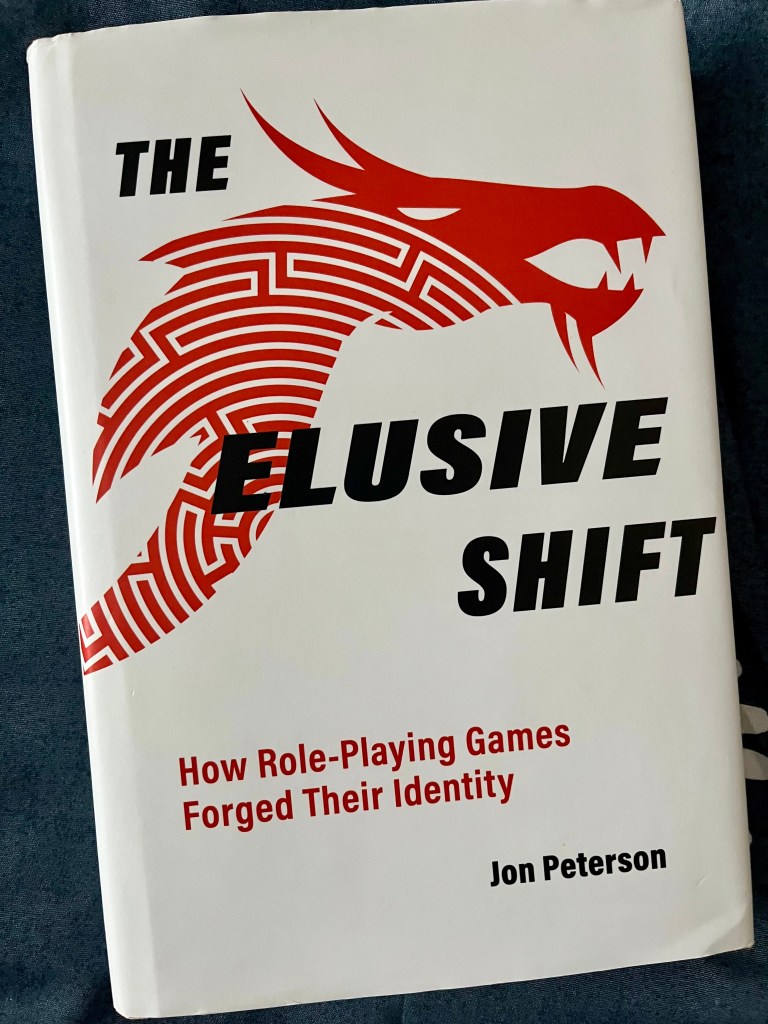
What strikes me most strongly is the impression that many of the discussions and debates about the nature of roleplaying games are themselves rooted in those early years. I couldn’t think of any controversial matter in the hobby today that was not raised and discussed in those formative years. We are in a loop.
I feel a deep connection to those early adopters of Dungeons & Dragons. I sense a strong affinity with the wargaming community which helped Arneson and Gygax conceive of their “rules for fantastic medieval wargames campaigns with paper and pencil and miniature figures.” I also share association with the science-fiction fandom that joined in after publication.
Growing up too late to be in the “first wave” of players of D&D, I was one of those much-maligned “munchkins” who entered the hobby in the late 1970s and early 1980s. We had no idea of the roots of these games we loved so much but we tried to play them in the best way we knew. Pre-internet, we taught one-another to run and play roleplaying games. We experimented.
“Playing at the World” is a portal back in time to allow an old Grog like me (ironically, I began as a “munchkin” and can end as a “Grognard”) to more fully appreciate the origins of this hobby I have dedicated the majority of my life to supporting and promoting. As I encourage new “munchkins” to join in the play, I am gladdened that times have made the hobby more acceptable and accessible.
There is so much to commend this exploration of “fantastic medieval wargames campaigns” to any interested soul. But I am most grateful to those pioneers who saw something more than a wargame and were able to persuade others to join them in a more character-focused role-playing experience.
“Playing at the World” is a fine introduction to the history of the hobby and a powerful reminder that creative endeavour is, at heart, a community project. As much as the creators of D&D might have resisted it, that first generation of players and GMs took their published vision and transported it ever deeper into the collective unconscious of us all.
Game on!


Yes, in general the hobby is still having Year 1 discussions, and pockets of it are privately talking or refusing to talk, about other matters. I don’t think it will ever change without more people like you making questions and experimentation feel expected and valuable, without the writing and publication side of the hobby moving away en nasse from template layouts with formulaic and semi-coherent content, and the buying public seeing the benefit of all of this.
Tall order?
Not really. I believe~
LikeLiked by 1 person