
In “How To Be a GURPS GM“, we read how a skill value of 12-13 is the level of the “Primary job skills of most normal people” (page 12). Today, I rolled an 11 which was enough to pass my skill checks with even the more challenging moments. Mundane stuff, of course, nets me a nice +4 or +5 bonus to those checks (GURPS Basic Set, page 345).
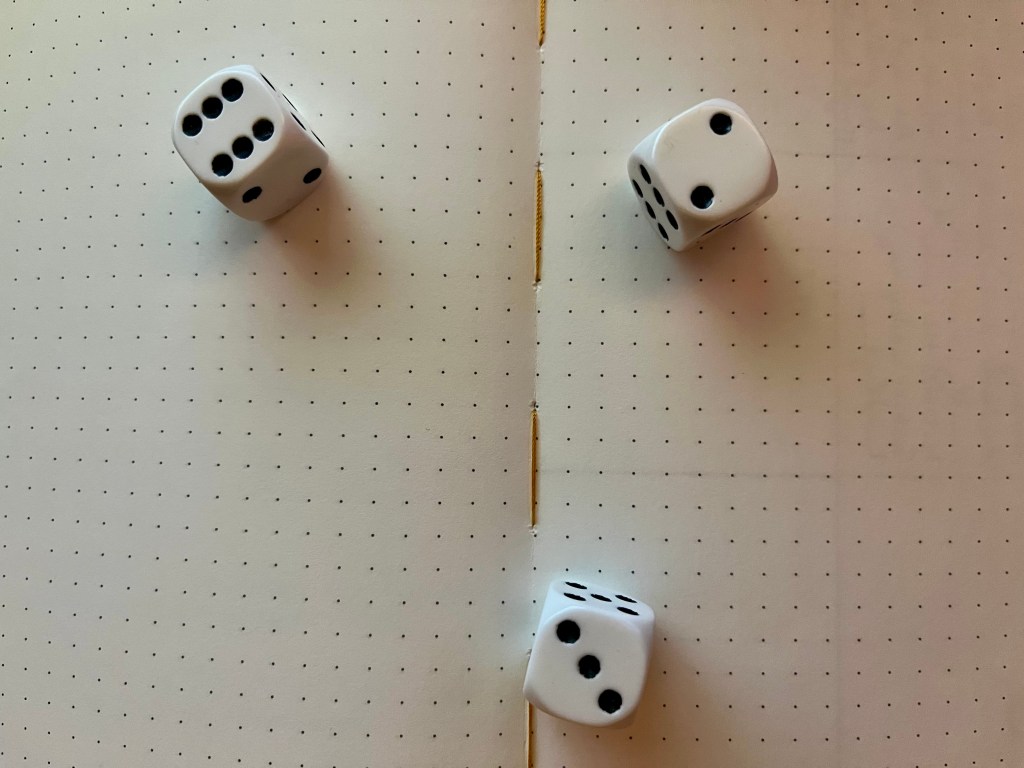
This is the stuff that I enjoy most about how the core 3d6 roll-low mechanism of GURPS works: characters have their skills rated to meet their supposed expertise but the modifiers assume that +0 is an “adventuring task”. Everyday stuff gives a chunky bonus to that roll of the dice.
It’s a great approach because it means that a character without training – and therefore using the skill’s default value – can still attempt and often succeed at mundane stuff.
For example, the untrained school teacher might have Teaching at the default of IQ-5. Looking at the typical teacher as being perhaps above-average with an IQ 11, they are still in with a shout on a typical task, netting a +4 or +5 to offset that default.
All of this feels about right. It’s a fair simulation of my experience: when I am under pressure, training and skill counts a great deal, but under routine conditions anyone can probably muddle through with a little luck. Let’s not forget that rolling an 11 or less on 3d6 happens 62.5% of the time.
Boosting your skill value to an 11 seems to be a pretty good bet. Recently, a friend suggested that any long-term character would be well-advised to have HT 11 as a hedge against dying and I can see the reason.
According to the GURPS books, having a skill of 11 is the place of “most skills, including hobbies, secondary job skills of volunteers, and primary skills of draftees.” (HTBAGGM, page 12).
Here’s to rolling an 11. I know I managed it today.
Game on!
 Roleplay Rescue’s Blog
The cool thing about the 3d6 bell curve is that a little change makes a big difference near the middle, but not much at the extremes. If you have decent but minimal training, so you have a skill of 10 for example, learning a bit more and getting to an 11 will net you a significant increase in your odds (50% up to 62.5%). There’s diminishing returns to increasing really high skill in normal circumstances, because each increase in level nets you a smaller percentage chance increase. Going from a skill of 15 to 16 only raises your odds from 95.4% to 98.1%, and skill higher than 16 doesn’t change your unmodified odds of success because 17 and 18 always fail.
What very high skill levels really let you do is handle penalties, so an expert (skill 16) doesn’t fail on average tasks more often than a world-class master (Skill 20) does, but the master can take on near impossible tasks (-10 penalty) with a 50/50 chance of suceeding.
If you have a skill level of 10, a slightly better or worse tool that gives you a +1 or -1 modifier will make a big 12.5% change to your odds of success. If you’re an expert with a skill of 15, minor changes in tool quality still affect your performance, but not as much (+2.7% or -4.7%), since your skill is more important than the minor variations in the tool. At the other end of the spectrum, if you are working off a default skill level of 5, the tool quality won’t matter as much either, because you won’t really know how to use it.
LikeLiked by 1 person