
A recent post from The Alexandrian helped me to crystallise a realisation that had been just on the edge of awareness for months. The idea of creating for myself a GM Toolkit from which I am able to mix and match differing elements for various games.
Here is the passage which clinched the realisation:
…my philosophy is much more about finding the Right Tool For the Job™. There are lots of different techniques you can use while playing a character, prepping a scenario, or running a game, and I’m far more interested in adding new tools to my toolbox and learning new ways to use the tools I already have…
The Alexandrian, “Spell Component Roleplaying” (24-12-23)
The section quoted is an aside designed to address those, “who are looking for the One True Way™ of roleplaying games”. In contrast, Justin uses the analogy of tools for the “toolbox” that he has assembled in his own practice as a Game Master.
Reading, “So You Want To Be a Game Master” reveals many of these tools and has been revelatory in itself. I have found myself energised and inspired by the methods and techniques gathered there from all that Justin has shared over nearly 20 years.
But the passage above triggered a connection that was hammered home by a later sentence: “I know that Once Upon a Time and Eclipse Phase can’t be played in the same way.” In other words, the particular set of game rules are also a part of the toolbox; you play certain rules for different effects.
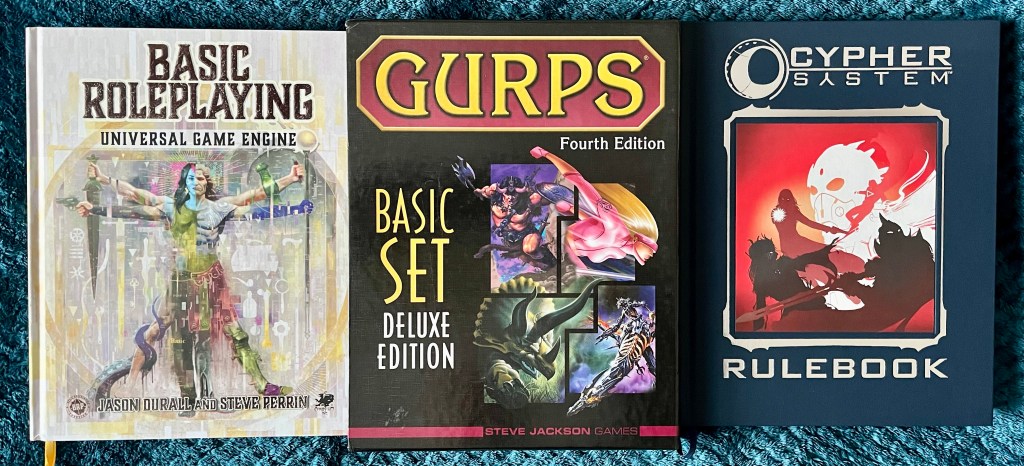
That’s when my desire to hold onto three very different “Toolbox Rulesets” clicked. My love for GURPS, BRP, and Cypher fell into sharp clarity: each game offers a range of mechanical tools calibrated to offer solutions for very different (although related) appetites in my play.
Put simply, GURPS is for the games where simulation and realism are paramount; BRP offers a step towards adventure (especially the near-Modern genre) still grounded in realism; Cypher is how I prefer to tackle cinematic action tales with lots of quickfire heroism.
Each rules system is a collection of tools in my toolbox, just as each technique or approach Justin gives in his GMing book is a tool for a specific need. The combinations of rules and methods provide us with a rich range of different game experiences.
We must note, of course, my usage of the word “game” here, by which I mean the combination of Methods, Rules, and World that creates an experience at the table. There is no “One True Way™” because there is no one single experience that I am seeking to offer and/or taste.
Which is neither to say that there is no place for the specific prescriptive set of rules either: playing RuneQuest, for example, offers me a deeply immersive World and some rules designed to emulate the heroic style of play within it (again, powered by BRP but honed to that World’s needs).
I’ve found this realisation freeing – as useful ideas tend to be – and was once more thrown back to the core conundrum that ails me: which Worlds, and experiences within them, am I seeking? The sense that I have various useful tools to deploy is enriching even as it pushes me back to consider the game World as the primary consideration.
The old viewpoint, that either you must have a new game system for every World OR that one set of Rules might be perfect for all things is more limiting. While I admit to a preference for learning and mastering fewer sets of Rules, I can also appreciate the value in seeking to own a small palette of games that do different things.
This is why some old products tarry on my book stacks and shelves: Traveller gave me tools for Universe-creation; original Alternity showed me a vision of science-fiction gaming that I hadn’t considered; RuneQuest 2e showed me the pathway to low-fantasy and more common magic. These old toolkits have individual tools worth saving.
I am grateful for the realisation that while I might be tempted by the desire for the “One True Way™”, in terms of Rules, Methods, and Worlds the more useful concept is this analogy of the GM’s Toolkit. I am now gathering the tools and feel more ready than ever to break them out at the table.
Game on!
 Roleplay Rescue’s Blog
There is a bit of online wisdom that a friend (Sameoldji) jokingly dubbed the Holy Trinity of RPG advice. These three elements are:
Talk with the Players
Play the Right Game
Don’t be the Problem
Amusingly, pretty much any gaming problem can be solved by the application of one or more of these elements. I find it to be an entertaining thought exercise.
Each point is bigger than it seems on the surface, but perhaps the second has the most extradimensional space crammed into it. It is not just brands, or the illusionary allegiances of old and new or trad and indie, or heaviness and lightness – it gets to the heart of this realization you have had: systems and procedures and intentions (among other things) can matter, and we can benefit from knowing how and when.
If everyone in the group is amenable to organizing and enjoying play in harmony with the group, then you are paying with the right people – which can’t be beat!
Glad to hear of this positive outcome and I look forward to hearing about the results~
LikeLiked by 2 people
The result will probably be that I begin experimenting with certain tools in each game that I run now. For example, this explains why running Fellmyr with Basic D&D works at school, given those circumstances. I don’t need to feel uncomfortable with those kinds of rules decisions.
LikeLiked by 1 person
Truth~
LikeLiked by 1 person