
In 1913, H.G. Wells wrote “Little Wars”. It’s a short book published along with “Floor Games” and available in an inexpensive format via Amazon. Unfortunately, this edition does not have the photographs alluded to in the text but it is well-enough written that this is not a critical flaw.
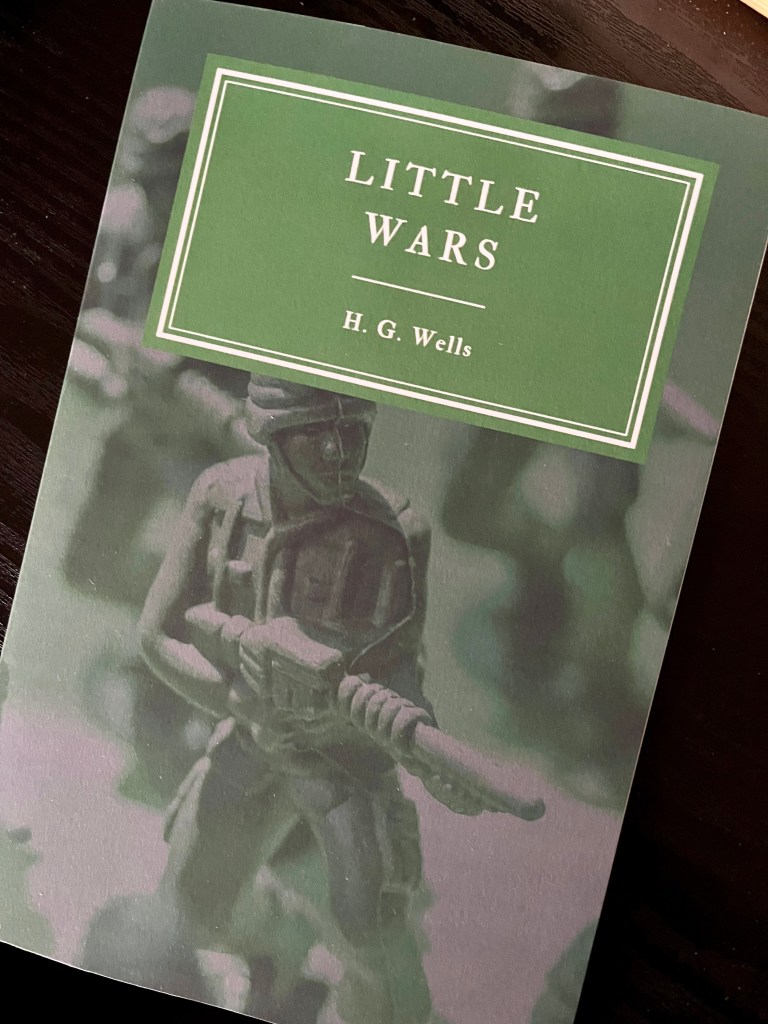
My wife bought me a copy and I’ve been re-reading it. I was lent a copy back in the days when I worked for Games Workshop, largely on the recommendation of John Stallard (founder of Warlord Games). It’s written in a delightful style which you can only describe as whimsical.
I noticed two things of potential interest to the roleplayer:
- Wells inadvertently includes roleplay in his game
- He distinguishes his “wargame” from Kriegspiel
On roleplaying, Wells describes an example battle in Chapter 4 by initially taking on the role of “General H.G.W., of the Blue Army.” His description of how “your author suddenly changes” and transforms into the image of the General is a clear example of roleplaying as we might envision it today. While it is amusing, this transformation is also highly evocative.
On Kriegspiel, Wells comments:
“…Kriegspiel, as it is played by the British Army, is a very dull and unsatisfactory exercise, lacking in realism, in stir and the unexpected, obsessed by the umpire at every turn, and of very doubtful value in waking up the imagination, which should be its chief function.”
He continues by thanking his collaborator, Colonel Mark Sykes, for:
“…advice and information in this matter. He has pointed out to me the possibility of developing Little Wars into a vivid and inspiring Kriegspiel, in which the element of the umpire would be reduced to a minimum.”
Wells believed and explained that Little Wars might provide a better platform for training junior officers than the existing methods. This fascinates me in the light of the celebration of Free Kriegspiel in RPG circles today.
British wargaming was strongly influenced by Wells’ approach and directly inspired the behemoth of fantasy and science-fantasy gaming, Games Workshop. Warhammer is undoubtedly a progeny of Little Wars and Wells’ desire for an entertaining game. Of interest to me is also the fact that Wells did not use dice in his rules.
I enjoyed the discovery of Wells’ whimsical use of roleplay on the nursery room floor (where he appears to have played). That he imagined himself the dashing General and can describe him in all his moustached glory warmed my heart. Here is Wells in-character as a wargamer. It reminded me of my own games in the past and the comments from others about such antics.
As for Kriegspiel, I was intrigued at Wells’ belief that the umpire was unnecessary this early in wargaming’s development. I know that the use of umpires remains in some circles until today, but it was gratifying to read Wells’ thought that wargames could be more realistic, more entertaining, and more engaging when fought with spring-loaded cannons and toy soldiers on his nursery floor.
All in all, I was reminded of the more innocent and gentlemanly days of the late Victorian and Edwardian eras. I was also amused by the “Floor Games” he played with his sons utilising building blocks, planks and squares of wood, model trains, and toy soldiers. It’s a grand old thing that the imagination of one of the greatest British authors was fuelled by such antics.
Game on!
 Roleplay Rescue’s Blog