
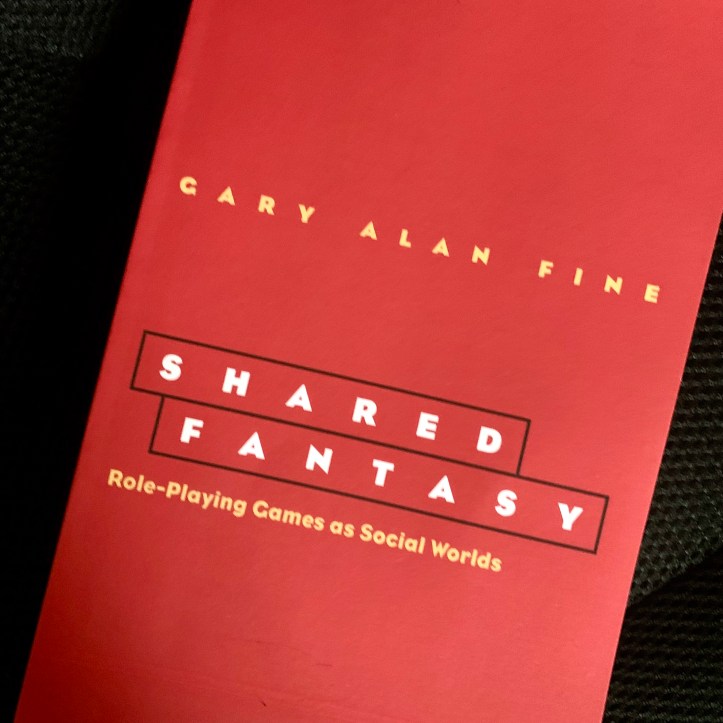
In his 1983 book, “Shared Fantasy”, Gary Alan Fine posited that roleplaying games need humans to operate in three different “frames” or modes of thinking. As we play the game, we switch between these frames – sometimes unconsciously.
The three frames are:
- Player Frame: the position of being the human at the table playing the game, eating chips, and drinking beer.
- Rules Frame: the position of interacting with the mechanisms of the game system, such as dice or character sheets or numbers.
- Character Frame: the position of making decisions in-role as if you were the character you are playing.
Cognitive psychology teaches us about “switching costs” when we move from one activity to another and making it clear that the idea of ‘multi-tasking’ is really switching between two or more activities, often very quickly.
Switching has a cost, cunningly known as a “switching cost”. Thus, moving from imagining myself in-role to then looking up stuff on my sheet, making a roll, and then going back to describe the outcome totals at least four switches between activities in two frames.
Each time I stop playing in role as-if I was my character – i.e. I switch from Character Frame to another frame – it costs me cognitive energy. The experience can be jarring, especially when you are deeply immersed in roleplaying your character and someone shifts you out to the other frames.
I get dumped out into Player Frame when my gaming buddies crack a joke outside of the character’s point of view, or when someone drops a movie reference the character would not know. This also happens when someone offers me more chips while I am roleplaying my way through an in-character dialogue.
I get dumped into the Rules Frame when someone asks me which spells I have prepared, or some detail from the character sheet, or when I get asked about how a rules works. There’s a weird oscillation between the Rules Frame and the Player Frame when we look up a rule in the books.
Given my goal is to remain as immersed in the Character Frame for as long as possible while we play, these distractions are frustrating. Sometimes they overwhelm my ability to maintain Character-immersion and even to believe in the Otherworld.
Conversations with fellow players can reduce the unnecessary interruptions but often the way we think about how to play RPGs is the problem. This methodology underlies all that we do at the table and sometimes it unnecessarily forces a frame switch.
For example, while skulking along a passage, my thief might be noticed by some unseen creatures. The GM could simply roll the dice quietly behind the screen and describe what my character experiences. I don’t need to roll those dice.
Similarly, while negotiating with a guard to enter a secure location, the character’s odds of success might be in question. You don’t need to ask me, the player of the “Face” character, to roll the dice. Anyone else could roll them, it doesn’t affect the pip’s result but it does mean I can remain in Character Frame.
I’m thinking about ways to reduce my frame-switching so that I can maximise the time I spend (as a player) in the Character Frame where all the magic of roleplaying happens. These are decisions around method, irrespective of the rules or world in play. As I remove frame-switches, I improve my Otherworld-immersed experience.
In the end, knowing what I want to experience helps me to work out how best to go about removing the obstacles to obtaining that experience. Frame switching and the associated switching costs are a huge factor in how a session feels. Don’t ignore them.
Game on!
 Roleplay Rescue’s Blog
Interesting take. I don’t know how many of players I game with would be open to the GM, or someone else rolling the dice for them. They seem to enjoy the switch to Rules Frame when they throw the dice. (Maybe Game Frame would be a better way to describe it? It seems to become more about ‘winning’, the immediate success or failure of the throw, and less about inhabiting the character or even achieving the character’s goals.) Even though it’s just a randomizer, a lot of players seem to invest a lot in making their own dice rolls.
I’m certainly intrigued about trying an experiment of GMing that way, or even more in playing in a game run like that.
LikeLiked by 2 people
One of the ways I try to get ahead of this frame switching is to have my players make several rolls before gaming begins, which I record and then use — in order — whenever a saving roll (etc) is needed for their character. This allows me to narrate the story with fewer breaks in the action.
LikeLiked by 1 person
I can see how looking up a randomised number from a list makes resolution faster, but I am curious about the value of the player making a bunch of dice rolls ahead of play. Why not have a random number generator produce a list of values and use those in order, saving everyone the time of rolling dice?
LikeLike
That’s a good question, and I did play with that idea. However, I feel that using numbers generated by the players themselves gives them a greater sense of control over their character’s fate… or at least makes them less likely to argue or question my impartiality.
LikeLiked by 1 person